
How to Read a Toxicity Study in Four Steps
How do you tell if a toxicity study you see online is reliable? AI summaries echo what popular wellness blogs say, not the facts from the studies themselves. Most alarming-sounding studies lose their edge once you do four things: find the actual paper (not just the headline), check what was studied and at what dose, resist the urge to extrapolate from a lab cell study to what actually happens in humans, and see whether it's one study or part of a consistent pattern. This section walks through all four in a practical way that doesn't require a science degree, and answers the bigger question of why environmental health research so often seems to contradict itself.
By Dr. Meg Christensen | Physician-founder of Interior Medicine, a non-toxic home resource built on her background in medicine, biochemistry, epidemiology, and clinical research.

Published May 11, 2026 | Updated September 2, 2026
Welcome to What "Non-Toxic" Actually Means, a free course on how to read product claims and navigate healthier materials more clearly. Stay here, or if you'd like the full arc, the Intro is the best place to start.
Part 3 takes ~14 min to read
Articles That Make You Go 😮
When you see a claim about a chemical, you probably pause and think, wait, is this real? That pause is perfect, but what usually follows is a set of quiet, invisible mental shortcuts to make your final yes or no decision. If you’re a skeptic, you may automatically often brush it off, and if you’re a wellness enthusiast, you might tend to assume the worst. This section gives words to the shortcuts we take and the people who are making the claim often take. Questioning your own first reaction isn't a knock on your instincts. It's how you stay open to finding out something is more interesting than you first thought.
There are a few places you see probably see alarming claims:
Social media videos: a research paper held up in the background as the receipt. The creator makes an alarming claim, the paper looks legitimate, and the reasoning seems to make sense. Sometimes they're right! But sometimes they're wrong, and often they’re sort of wrong. Reading research carefully is quite difficult, even for the people who do it for a living. Social media, the Land of Nuance (just kidding), rewards alarmism and makes this all harder.
Google results and AI summaries: these echo what the most popular blogs say, and not necessarily the truth. For example: I was recently trying to track down whether formaldehyde in toilet paper is still a problem in 2026. The first several pages of search results, including the AI summary at the top, all said yes. But looking at the source names showed the information was all coming from big wellness blogs. It took some digging to find the latest primary research studies. It turns out the practice mostly stopped a while ago, and old information is still being echoed around.
The four steps below are the steps I use on myself and others. The goal is to use discernment (this guy: 🤨) instead of automatic acceptance. Think about reaching for these steps whenever a claim gives you a flash of alarm, but also whenever one gives you that satisfying flash of told-you-so. It takes about 5 minutes, and you might surprise yourself.
We'll walk through all four steps with one example: the claim that PEVA shower curtains are toxic.
Step 1: Find the Actual Paper
How to Find an Original Research Article Online, Not an AI Summary
Start by finding the original paper online. This is getting very hard to do with AI summaries, but it’s important to do, because AI summaries just tell you what the most popular blogs think about the study. Use one of three methods:
Use Google Scholar instead of regular Google. Typing in “PEVA toxicity study” immediately brings up research papers about it, not a summary of wellness blogs opinions on it, which dominate on regular Google.
Search for it in regular Google, but once the results come up, click “More” at the top of the page and select “Web.” This brings up the old-fashioned non-AI summary, and is an easier way to find what you’re looking for.
Use a web browser that doesn’t rely on AI summaries, like DuckDuckGo or StartPage.
How To Find the Title of Study About a Health Claim
Take a screenshot: if someone makes a health claim on social media, take a screenshot if they show the paper in the background so you can get its title. Or, sometimes they’ll have a direct link to it in the comments below, especially on YouTube.
Follow the link: news articles will sometimes use inline direct links to articles. Or, look at the bottom in the references section to find the link.
If you don’t have the exact title of the paper: if there is no title and just a vague statement like, “new research shows,” ask them, or try your best to search the closest phrase you can get with the steps above.
When the results come up, look for the original scientific article. It’ll come from PubMed or a scientific journal name, not a press release, news piece, or a blog.
When you do this for the PEVA claim, here’s what comes up:
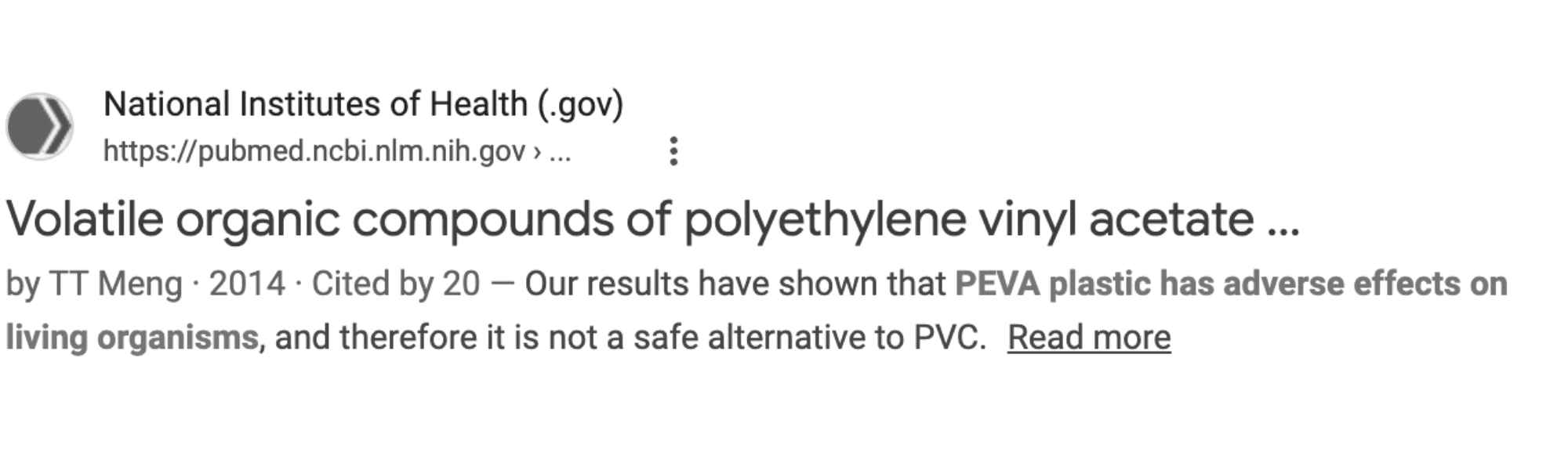
When the result for the paper comes up, ignore the often attention-grabbing summary line (you'll see in Step 3 that the actual conclusions are usually much more careful). Click through to open it. Just by pausing, searching, and opening the article, you've put yourself, not the person making statements, in charge of what to make of it.
-
Step 1Pause. Google the title and open the paper.
-
Step 2
-
Step 3
-
Step 4
Step 2: Skim the paper. What did they do, and what did they find?
You don't have to read the full paper. Just answer these four questions. Start with the Abstract, which is the short summary at the top. That often gives you enough.
If you need more, open the full text and jump down to the end to look at the Methods and Conclusion sections, too. What you're looking for is: what was studied, at what dose, under what conditions, and what the authors actually concluded.
For the PEVA example, just getting to this step is where any worrying (or told-you-so) starts to fall apart:
What was studied: people vs. animals vs. cells in a petri dish. The PEVA study used aquatic worms that don't have lungs, a liver, or kidneys.
At what dose: 1000x typical exposure vs. realistic levels. For the PEVA study, VOC fumes were extracted from PEVA by heating it in a 150°F water bath.
Under what conditions: sealed chamber vs. a regular room. For the PEVA study, the worms were put in a sealed chamber with the VOCs for eight days.
What the authors concluded: a verdict, or something more careful? The PEVA paper's title implied certainty (PEVA is harmful). The conclusion section was much more careful: effects were observed under the specific high-temperature, sealed-chamber, multi-day conditions used in the study, and the authors called for further research, particularly in mammalian models, before any conclusions could be drawn about human health.
-
Step 1Pause. Google the title and open the paper.
-
Step 2Skim the paper. What was studied? At what dose? Under what conditions? What did the authors conclude?
-
Step 3
-
Step 4
Step 3: Watch for the Leap!
This is the silent step that catches almost everyone, including people with research or science backgrounds. It's often where the person in a viral video goes wrong.
Once you see what a study found, the mind reaches for the next step almost automatically: well, if it does this in worms, it would probably do a smaller version of that in people, right? And we use shower curtains every day, so even a small effect would add up over time… Or, going the other direction: worm studies always overstate things, so this one probably doesn't mean anything for humans. In short, we love to extrapolate.
Extrapolation feels right because it follows a logical chain of thought. But the chain often doesn't hold up to actual science, and this is exactly how someone turns a screening study on aquatic invertebrates into "PEVA shower curtains are toxic" (or "this study means nothing, ignore it entirely.") Watch for the urge in yourself, and watch for it even more carefully in whoever is making the claim, because they had to take the leap first to make the video at all.
A few specific traps to watch for:
The species jump: assuming a chemical that affects one organism will affect another, even when the two species don't share the relevant systems. The PEVA worms don't have lungs, a liver, or kidneys, which are the three systems most relevant to how a human would actually inhale and detoxify a VOC.
The dose jump: assuming an effect at high doses scales smoothly down to low doses. Sometimes it does, but often it doesn't. Many substances have threshold effects (no harm below a certain dose) or non-linear dose-response curves, both of which we covered in Part 2. "1000x exposure causes harm" doesn't automatically mean "1x exposure causes 1/1000th of the harm."
The conditions jump: assuming an effect under extreme conditions translates to normal ones. The PEVA study used 150°F water in a sealed chamber for eight days. A 90°F bathroom for 10 minutes is a completely different situation, not just a smaller version of the same one.
The repeated-exposure jump: assuming brief exposures repeated over years equal a single sustained exposure. Some chemicals do bioaccumulate and act this way, but most don't. The body clears most things between exposures.
The better answer to "couldn't this big risk in worms mean a small risk in us?" is: maybe. This study illustrates that the only way to know for sure is from more research, in better-designed studies, in species closer to our biology. A single screening study isn't a basis for extrapolating. It's a basis for asking the next questions.
This is why a lot of environmental toxin research takes so long. The gap between the studies we can do and real-life exposure is very wide, and bridging it ethically takes time.
Finally, resisting extrapolation means a willingness to sit with uncertainty, to make our best decisions with what we know, and to leave room for the mystery of how all of this actually works. It doesn't mean you can't take action. Choosing to avoid a substance because the science isn't settled isn't giving in to fear-mongering. You can do it out of precaution and respect for how much we still don't understand. The difference between that and blindly accepting someone else's extrapolation is that you've made the choice yourself, knowing exactly what's known and what isn't.
-
Step 1Pause. Google the title and open the paper.
-
Step 2Skim the paper. What was studied? At what dose? Under what conditions? What did the authors conclude?
-
Step 3Resist the urge to extrapolate. Sit with what we don't know yet.
-
Step 4
Step 4: Zoom Out. Is this one weird study, or one of many?
Steps 1-3 work well to tell you what any single research paper is saying about a substance, which is great. But, one study doesn’t mean a lot. We need lots of well-done studies done on lots of different people to see if the results are the same over and over. Step 4 helps you tell whether the paper was one weird study that might not mean much, or if it’s worth paying attention to. The best ways to tell:
Google the substance name plus "ATSDR." Scroll past the AI summary to the real results, or search in web mode or a non-AI browser. If a result shows up, this gives you the highest quality synthesized answer written by researchers.
Use AI tools that synthesize research specifically: Consensus and Elicit are options.
Use a blend of Google Scholar and Claude or ChatGPT: Download the papers from Google Scholar yourself, then upload them into Claude or ChatGPT to synthesize their findings. You can even ask it to follow the steps we covered in this section when it gives you a summary.
These are the signals that these syntheses are looking for:
Quantity: ten studies is a stronger signal than one study.
Quality: a well-designed study is stronger than a sloppy one. Predatory journals will publish almost anything for a fee, while legitimate journals require peer review before publication.
Study type: cell and animal studies are useful for screening but don't always translate to humans. Observational studies in people are better, but can't prove causation on their own. Randomized controlled trials with lots of people in a control group and in an experimental group are better. Summaries of many studies put together (often called "review articles" or "meta-analyses") are even better. Reviews by official agencies (like ATSDR, IARC, EPA, or NTP) that bring everything together, weigh study quality, and issue a judgment are the strongest.
Consistency: do the studies agree, or do they contradict each other? Twenty studies pointing the same direction across different populations, methods, and research groups is much stronger than twenty with mixed results.
-
Step 1Pause. Google the title and open the paper.
-
Step 2Skim the paper. What was studied? At what dose? Under what conditions? What did the authors conclude?
-
Step 3Resist the urge to extrapolate. Sit with what we don't know yet.
-
Step 4Zoom out. Is this one weird study, or one of many that agree?
What if it is just one weird study?
This won’t come up often. But when it does, here ‘s what you can do. This is a bonus fifth step.
If it’s truly just one study that exists (which actually is the case with PEVA) you probably want to know: is this the first groundbreaking study of something new and alarming we should pay attention to? Or, is this a poorly done study that I can ignore? Checking for a conflict of interest is often helpful.
How to Tell if a Research Journal is Predatory or Legitimate
Predatory journals will publish almost anything for a fee, while legitimate journals require peer review before publication. This means an alarming study can be published even though it was done in an unethical or sloppy way. And, a PubMed listing alone doesn't guarantee quality, because PubMed is a search index, not a quality filter.
The fastest way to check this is to Google the journal name plus the word "predatory."
For a more rigorous check, search the journal at the NLM Catalog and look for "Currently indexed for MEDLINE."
The PEVA study was published in a small journal, but it isn't considered a predatory one.
How Do you Know Who Funded a Research Study?
At the top or bottom of the paper, look for who the researchers are and who paid for the work. Are any conflicts of interest declared? An industry-funded study isn't automatically wrong, and an advocacy-funded study isn't automatically right, but both are reasons to read more carefully.
Final Call on PEVA Toxicity
Right now, we just can’t say definitively that PEVA shower curtains are toxic to humans. But also: we can't say PEVA shower curtains are definitively safe, because the evidence base isn't there for that either.
Again, even when the evidence is early, choosing to avoid something is still valid. You could be extra cautious. You could avoid it out of care for the workers exposed to it. We dive deeply into the difference between the facts vs. what you choose to do with them in upcoming sections of the course.
Why Does Environmental Toxin Research Contradict Itself So Much?
You've probably noticed that for almost every chemical, there's a study saying it's harmful and another saying it's fine. That’s because this is what early-stage research looks like, and the field of environmental medicine is still relatively young.
Studies on environmental toxicants are mostly observational, because researchers can't randomly assign people to exposures and watch what happens. They have to work with populations who are already exposed, which means other variables (diet, air quality, income, stress, age, what else they're exposed to at the same time) can explain the finding instead of the chemical itself.
For example, a study might link a chemical to higher rates of asthma in one neighborhood. But if that neighborhood also has more highway traffic and more trees with pollen, either of those could be the actual cause. If you observe the same chemical somewhere else, the pattern might disappear because the highway traffic and pollen levels aren't the same. That's normal and expected at first. But over time, and sometimes it takes a long time, you get enough studies that the real pattern starts to emerge.
With environmental research, it's better to pay attention to the forest than each individual tree.
The Six Step Framework, Now with Research
Each step of the six-step framework we covered in Part 2 can have a different amount of research supporting it. The hazard might be well-studied while the actual exposure pathway has zero research. Or, we might know a lot about the body’s response to various doses, but very little about who's most susceptible. Without good research for all of the first five steps, it’s really hard to come up with a good risk assessment.
Below, I’ll show you an example with PEVA compared to PFAS. Each box in the framework is filled in according to how much research supports it. I use four levels to keep it visually simple. Each level represents everything we just covered in Step 4 above: how much research exists on a substance, how good the research quality is, what types of studies have been done, and whether the results agree or not.
For PEVA right now, you’ll see we have a little information about its hazard profile (one study), but we don't have any information about exposure pathways relevant to humans, dose-response, or susceptibility. We can’t come up with a good risk assessment.
Compare that to PFAS, which has decades of research, multiple agency reviews, and consistent findings across the framework. We can definitely say that PFAS are risky, or toxic:
Next: Part 4
And now we have perfect risk frameworks, with every box perfectly filled, ready to make perfect risk assessments.
Just kidding! The boxes are almost never all filled. Part of being honest about risk is sitting with what we don't know yet, and that's what Part 4 is all about. It’s a shorter section, and mostly visual.
Part 3 References
The four steps above aren't a new system I'm proposing. They're what I personally use when I see a research claim about a chemical. They’re methods distilled from established frameworks for evaluating research and online sources: SIFT, GRADE, and CRABS. Those frameworks are excellent, but I know most people won’t use them because they are complicated and take time. I wanted to honor the reality of how we see most non-toxic content and give you the honest steps I use instead of the idealized ones. Here's what I changed and why:
I focused on what catches the most claims fastest. Most of us aren't motivated to settle in and apply research checking frameworks carefully during a social media scroll, so the four steps above will flag the majority of bad claims on their own, in a few minutes, on your phone.
I emphasized looking at dose and exposure. This is where most misleading claims in non-toxic spaces come from. A study finds a harmful effect at 1000x typical exposure in worms, and a video turns it into "this chemical is toxic" without ever mentioning the dose or the fact that the species studied doesn't even have a liver.
I separated out the extrapolation piece. In most frameworks, this is a silent step that gets folded into "evaluate the methods" or "consider applicability." But I think extrapolation is the actual move that turns a screening study into a panic post, and naming it as its own step makes it visible enough to catch yourself or someone else doing it.
I dropped the "who is making this claim" check. Authority and credentials absolutely tell you something, but they're not everything anymore, especially on social media where the lines are blurred. There are MDs who are also wellness influencers, and I've seen them make claims that don't hold up. Some wellness influencers without credentials are incredibly careful about the claims they make. So the four steps focus more on what's being said, not who's saying it.
Assessment frameworks references
Guyatt, G. H.; Oxman, A. D.; Vist, G. E.; Kunz, R.; Falck-Ytter, Y.; Alonso-Coello, P.; Schünemann, H. J. GRADE: An Emerging Consensus on Rating Quality of Evidence and Strength of Recommendations. BMJ 2008, 336 (7650), 924–926.
Caulfield, M. SIFT (The Four Moves). Hapgood, June 19, 2019.
Stokes-Parish, J. Navigating Health Misinformation: Use of the CRABS Framework as a Tool for Health Professionals. J. Med. Internet Res. 2022.
Grudniewicz, A.; Moher, D.; Cobey, K. D.; Bryson, G. L.; Cress, S.; Frank, K.; Manca, M.; Lem, M.; Dobler, G.; Shamseer, L.; et al. Predatory Journals: No Definition, No Defence. Nature 2019, 576 (7786), 210–212.
PEVA study and vinyl acetate monomers
Meng, T.T. Volatile Organic Compounds of Polyethylene Vinyl Acetate Plastic Are Toxic to Living Organisms. J. Toxicol. Sci. 2014, 39 (5), 795–802.
ATSDR. Toxicological Profile for Vinyl Acetate. U.S. Department of Health and Human Services: Atlanta, GA, January 2025.
Scientific Committee on Health and Environmental Risks (SCHER). Scientific Opinion on the Risk Assessment Report on Vinyl Acetate, CAS 108-05-4: Human Health Part. European Commission: Brussels, November 17, 2008.
PEVA vs PFAS frameworks
ATSDR. Toxicological Profile for Perfluoroalkyls. U.S. Department of Health and Human Services: Atlanta, GA, 2021.
Explore More Interior Medicine




Product Reviews
Tools and Resources
About Interior Medicine
Clinical