
Non Toxic Cutting Boards
The safest cutting board is a raw, unfinished solid piece of wood with no glue, and unfinished titanium is the second-safest option. I evaluate cutting boards layer by layer, including glues and finishes, then rate each layer using consistent material health scales, all explained in my full methodology.
By Dr. Meg Christensen | Physician-founder of Interior Medicine, a non-toxic home resource built on her background in medicine, biochemistry, epidemiology, and clinical research.

Updated June 5, 2026
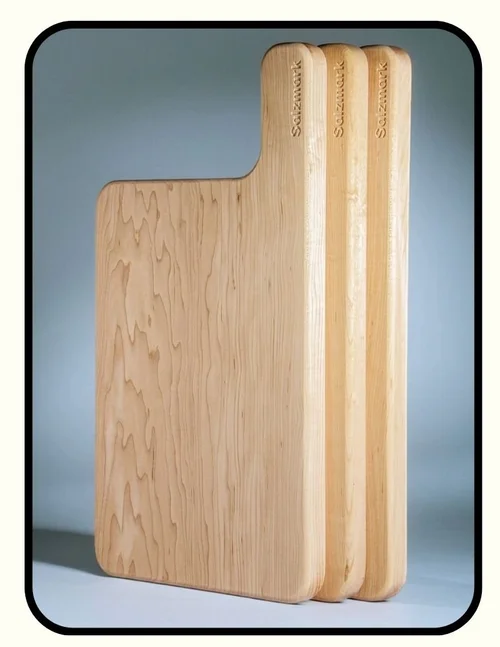 Salzmark Solid Wood Cutting Boards
Salzmark makes non-toxic solid wood cutting boards and they get it: an unfinished piece of solid wood kills bacteria faster than any finished or plastic board. And even better, they don’t have any glue holding the wood pieces together. Spendier than other options here, these are made in the US from a carved block of solid maple wood with no other ingredients. Thick and sturdy so won’t warp.
Product rating
See the rating scales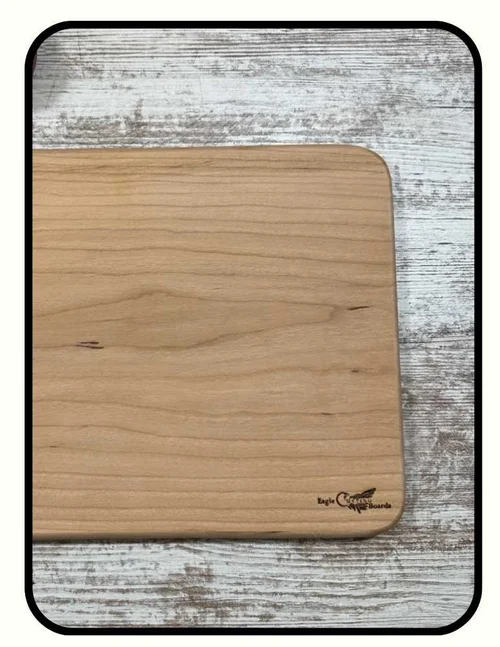 Eagle Non-Toxic Cutting Boards
This is the most affordable non-toxic cutting board and is under $50 for even the largest size. No handle, and thinner than Salzmark, but still made of solid, unfinished, cherry wood. A great no-glue cutting board. These come in a variety of sizes and are available through Etsy.
Product rating
See the rating scales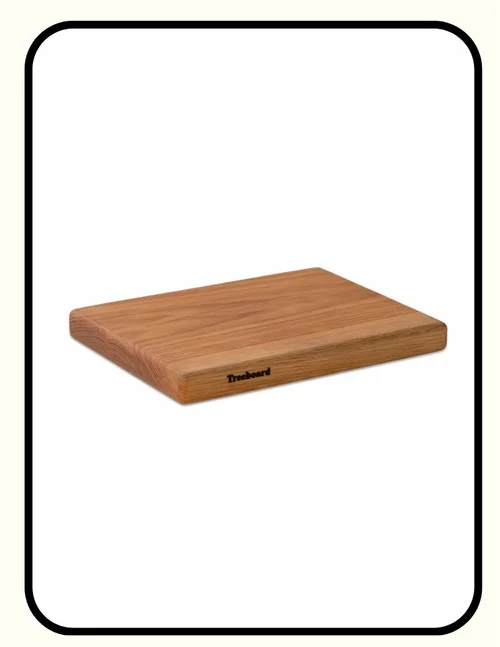 Treeboard Safe Cutting Board
A moderately priced solid wood cutting board option, Treeboard is unique for having customized engraving, silicone feet options for lifting it off the counter, lots of sizes, and healthy oils. While the fastest most effective way to kill bacteria on a wooden cutting board is having no finish (read more below) the second healthiest option is using 100% natural oils, so Treeboard’s linseed oils and carnauba balm are a good pick.
Product rating
See the rating scales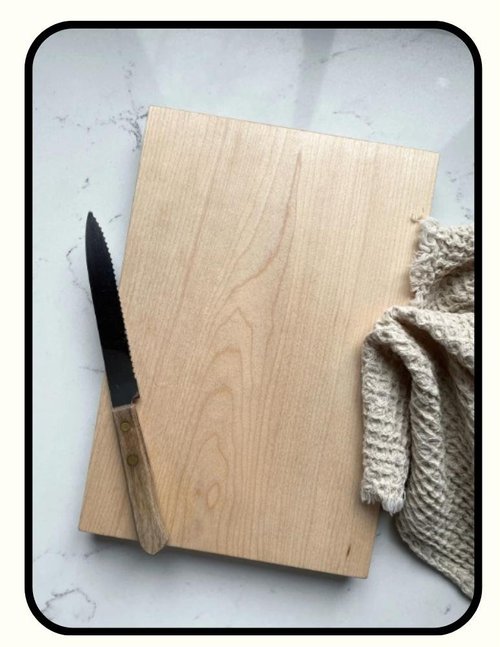 Nate and Kate Non Toxic Cutting Board
A small business owned by a couple, Nate and Kate offer solid slab cutting boards made with just maple or black walnut wood. They come in several sizes, and if you want to wax them, they have organic carnauba, beeswax, and coconut oil balm blend available.
Product rating
See the rating scales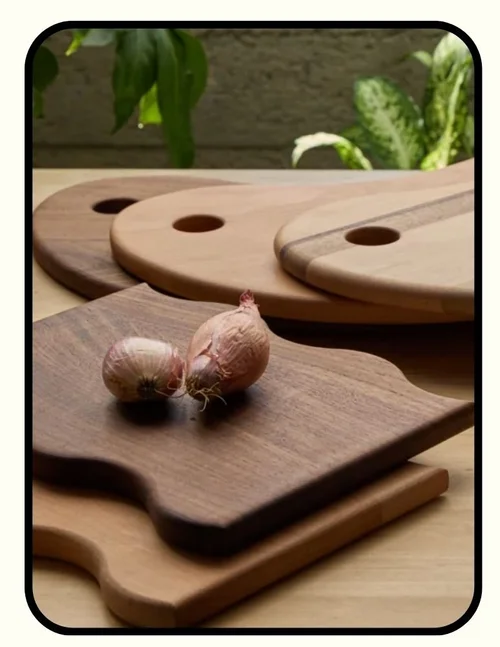 Avocado Zero Waste Cutting Boards
If you choose a cutting board made with finishes or glues, just go with a brand that discloses exactly what they are. I love Avocado for their transparency and their materials are still far better than most cutting boards. They use beechwood or walnut, finished with linseed oil and beeswax. They’re held together with the same wood glue that they use in their bed frames that are GreenGuard GOLD certified for very low VOC emissions. The Titebond wood glue they use has been approved for indirect food contact.
Product rating
See the rating scales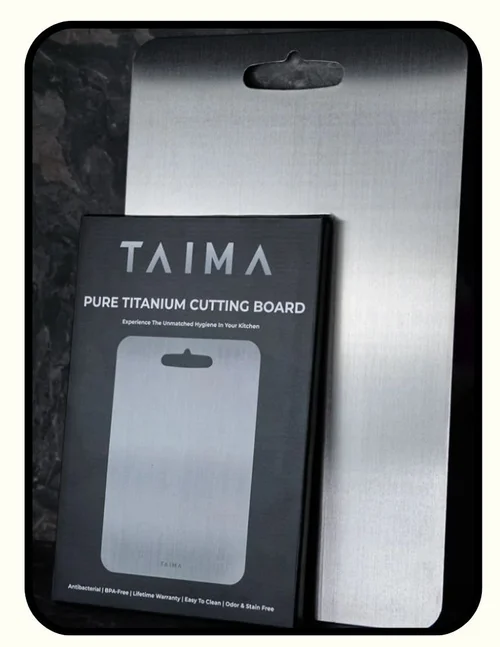 Taima Pure Titanium Non Toxic Dishwasher Safe Cutting Board
This is the best dishwasher safe non toxic cutting board. Made of pure titanium, it won’t get any grooves in it like plastic does where microbes can multiply. It also won’t release microplastics! Titanium is softer than stainless steel so won’t dull your knife, isn’t slippery like a glass cutting board, and is dishwasher safe. No glues, finishes, or synthetic antimicrobial agents. Made of 100% titanium.
Product rating
See the rating scalesLooking for something specific? If you don't see the product or brand you're curious about, you can request a review here, or run it through the Product Checker to evaluate it yourself. Want to go deeper? My free course covers how to evaluate any product's materials yourself.
Join the Newsletter
Join the Newsletter
More Healthy Design For You
Pots and Pans
Non-Toxic Blackout Curtains

Bakeware
Top 5 Places to Start

FAQ About Non-Toxic Cutting Boards
Are wooden cutting boards safe?
Yes, and they are safer than plastic.
The idea that plastic is safer than wood cutting boards makes sense on first thought — plastic doesn’t have pores, so any bacteria can be washed off, whereas wood is porous and absorbs liquids and the bacteria in them, making the absorbed bacteria impossible to get rid of. But, it turns out that’s not true. Wood cutting boards, particularly unfinished raw wood cutting boards, are safer than plastic. Here is why:
Dr. Seri Robinson, a professor of wood anatomy, explains that wood does indeed absorb liquid and bacteria deep into the wood fibers of the cutting board, because wood likes to distribute moisture evenly. But, once the cutting board dries and all the water evaporates out of it, the bacteria stays trapped in the wood fibers and dies there, because they don’t have oxygen or moisture. Once bacteria are absorbed, they do not migrate back out to the surface. Very little is detected on the wood after 10 minutes, and essentially zero is after 24 hours. An amazing study was done on this: Salmonella and Listeria were put onto different types of cutting boards, then wiped up, and analyzed to find these results.
Bacteria left behind on the surface of a plastic cutting board multiplies.
Finally, wood is naturally antimicrobial: bacteria tend to die quickly when exposed to wood. This is thought to be in part due to wood’s low pH, and also because wood is a plant with active compounds.
What is the safest cutting board?
A raw, unfinished solid piece of wood with no glues or finishes is the safest material. Unfinished 100% titanium is the second safest. Both avoid the adhesives, surface coatings, and added chemistry that introduce most of the exposure risk in cutting boards.
Can bacteria hide in knife grooves on cutting boards?
Yes, but it is only primarily a problem for plastic cutting boards. Because plastic doesn’t have wood’s wicking action, the bacteria can get trapped in grooves. If you use plastic cutting boards, it’s important to replace them when you see visible grooves.
If I disinfect my plastic cutting board, is it safer than a wood cutting board?
No. Plastic cutting boards release microplastics into your food, as well as any of the chemicals blended in with the plastic itself, like BPA, PFAS, dyes, and other additives.
Will mold grow on my wooden cutting board?
Mold will only grow on a wooden cutting board if water doesn’t evaporate. Mold requires water to survive, so be sure to let your wooden cutting boards dry completely on a rack before putting them away to prevent this.
What is the safest type of wood for a cutting board?
A solid piece of unfinished, open-grained wood is the best type of wood for a cutting board. That may surprise you, but woods that readily wick liquid tend to pull bacteria off the surface and into the wood, where it can't multiply. We learned a lot about this in 2023, and it ran counter to the old assumption that tight, less porous wood or coated wood would repel bacteria better. It turns out those act more like plastic, leaving more bacteria on the surface where it survives. Species matters too, not just porosity: in the main study about this, European beech performed best against Salmonella and oak performed best against Listeria.
What is the safest type of finish for a cutting board?
A cutting board without finish is the safest and most antimicrobial option, because raw wood is best at drawing bacteria off the surface. In testing, coated woods left significantly more recoverable bacteria on the surface than uncoated ones, with no meaningful difference between oil types.
If you like the look of a finish, use a non-toxic plant-based oil. Avoid excessive layers, as well as waxes, shellac, and varnishes, which block water absorption and the antimicrobial action that comes with it.
If you already own a finished wooden board, it's still much better than plastic and doesn't need replacing. It will still reduce bacterial load, and it isn't shedding microplastics into your food. If you sand it smooth, don't overdo it. Anything finer than 400 grit may slow the killing of bacteria.
Why does a Prop 65 warning come with my unfinished raw wood cutting board?
This is because Prop 65 takes into account possible exposures that not just you, but the workers making the products are exposed to, and wood dust is technically associated with nasal cancer— this is a concern in workers that don’t wear a mask while breathing it in all day. You will not be exposed to any wood dust from your cutting board.
Are bamboo cutting boards non-toxic?
Bamboo itself is fine, but a bamboo board is built from many thin strips glued together, so the adhesive is the layer that matters, not the bamboo. Even a low-tox glue carries some exposure possibility, and bamboo uses a lot of it relative to solid wood. Since bamboo offers no real advantage over a solid wood board, there's little reason to accept the extra glue. A bamboo board is only as safe as the adhesive holding it together.
Are paper composite or wood fiber cutting boards non-toxic?
No. These boards are wood fiber or paper bound together with resins, and that resin can carry the same concerns as plastic. You're cutting on the binder, not the wood, so the material health of the board comes down to what's in the resin. I don't recommend them.
Are acacia wood cutting boards non-toxic?
It depends on how the board is made. Acacia is a hardwood and the wood itself is fine, but most acacia boards are built from glued strips (edge-grain or end-grain), so the adhesive becomes a layer to evaluate. A solid, single-piece acacia board with no glue and no finish is a safe option. A glued, finished one is only as safe as its glue and finish.
Are FSC certified birch cutting boards non-toxic?
It depends on the glues and finishes, not the certification. FSC certification tells you the wood was responsibly sourced, but it says nothing about the adhesive or coating, which are the layers that drive the health profile of a board. Birch wood itself is fine. A solid, unfinished piece is a safe choice, while a glued or finished birch board comes down to what's in those layers.
Do cutting boards really have 200 times the amount of fecal bacteria as your toilet seat?
No! This myth caught on because it sounds shocking. It started in 2014, and is consistently repeated by media outlets even now, however, the “original study” doesn’t actually exist — Food and Wine did a bit of journalistic investigation on this and you can read more here.