
Non Toxic Pillows
The best non-toxic pillows are made from GOLS-certified organic latex, GOTS-certified organic wool or kapok, or OEKO-TEX certified materials, with no polyurethane foam or chemical flame retardants. Your pillow touches your face, mouth, and airways for roughly a third of your life, more contact than almost anything else you own. But pillow marketing can be murky: brands make vague "non-toxic" or "natural" claims without third-party certification to back them up. So I evaluate every material using the same method for each, all explained in my full methodology.
By Dr. Meg Christensen | Physician-founder of Interior Medicine, a non-toxic home resource built on her background in medicine, biochemistry, epidemiology, and clinical research.

Updated June 30, 2026
Best Non-Toxic Pillows for Combination Sleepers
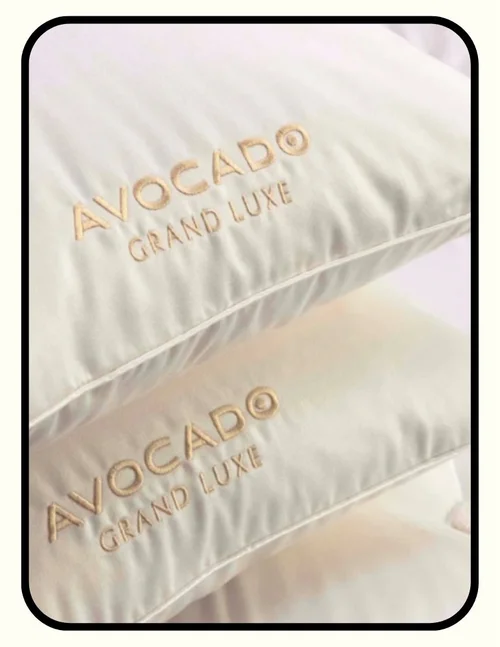 Avocado Grand Luxe Non-Toxic Pillow: Best Luxury Pillow for Mixed Position Sleepers & Guest Rooms
This pillow is 60% pure Talalay latex shreds and 40% down, so it strikes that tricky balance of springy support and sinking-in airyness, which is good if you’re moving from your sides to your back throughout the night. It’s encased in a layer of organic wool and cotton, and every single material has the most rigorous certifications and details, which I always love about Avocado. It also works really well for guests which will have a range of sleeping styles that you don’t always know. It’s nice to impress your guests with this kind of luxurious comfort, too. Often sold out for all these reasons.
Product rating
See the rating scales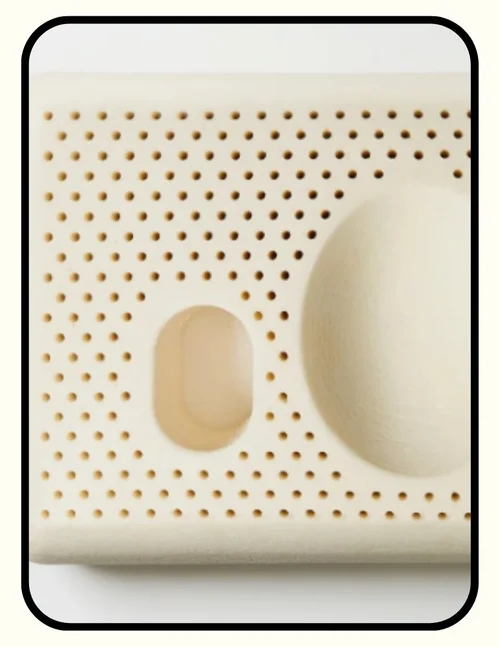 Coyuchi Organic Latex Side Sleeper Pillow: Best for Side-Back Combination Sleepers
Coyuchi’s Turiya pillow is super unique—made of 100% GOLS-certified organic Dunlop latex with built-in ear cups and a central head cradle for switching between side and back sleeping. Chiropractors recommend keeping your neck supported while having a little dip for your head if you’re a back sleeper. This pillow gets that exactly right, along with the ear cup design for when you move to your side. Also great for people with piercings, ear sensitivity, or earbuds-while-snoozing-wearers that like to sleep on their side. Dunlop latex is firmer than Talalay while still being cushy, providing excellent neck support in any position. Encased in GOTS certified organic cotton (not obvious on their product page— I emailed to ask.)
Product rating
See the rating scales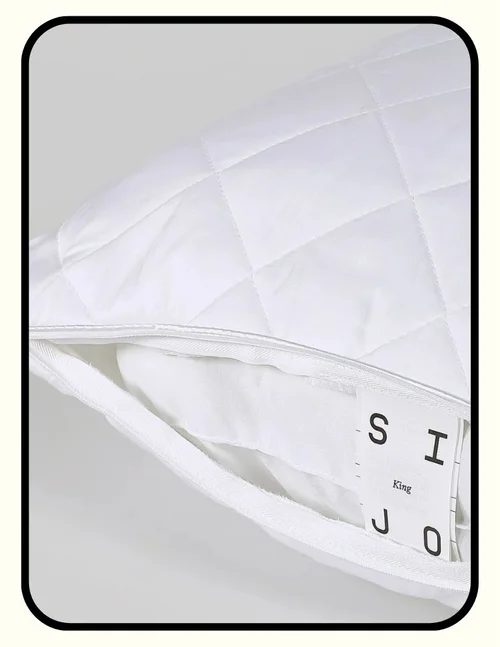 SIJO FluffBase Eucalyptus Pillow: Best Affordable Low Tox Pillow for Combination Sleepers
Well under $100, these pillows are made with affordable, lower tox materials. While not organic, the encasements on these are made of eucalyptus (Tencel) which is known for being quick-drying and cooling, and it’s stuffed with GRS and OEKO TEX-certified polyester. Both are important certifications, especially for recycled polyester, ensuring they’re safer for humans as well as the planet. These pillows are allergy-friendly as well, even certified by the Asthma and Allergy Foundation. These are well loved as being perfect for combination sleepers that switch between their back, side, and even stomach.
Product rating
See the rating scales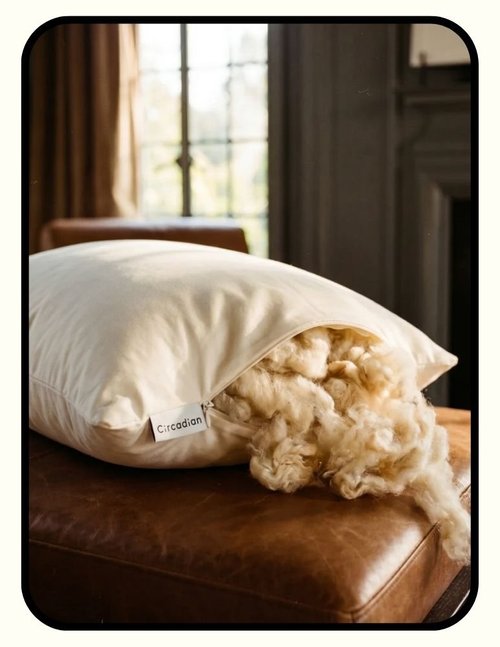 Circadian Rest Organic Wool Pillow: Best for Customizable Support
If no pillow ever seems to be quite the right height, an adjustable fill solves the problem at the source. This one is filled with GOTS certified organic wool inside a GOTS certified organic cotton cover, which puts it among the healthiest pillows I've evaluated from a material standpoint. Wool is naturally thermoregulating, pulling heat and moisture away from your head, so the pillow stays cool through the night instead of storing warmth the way foam does. That same moisture resistance makes it inhospitable to dust mites, which matters if you regularly wake up congested or sneezing. I tested this pillow myself over the summer and after a little break-in period I had the loft dialed in exactly where I wanted it, and it's stayed supportive and cool since. Impressive!
Product rating
See the rating scalesBest Non-Toxic Pillows for Side Sleepers
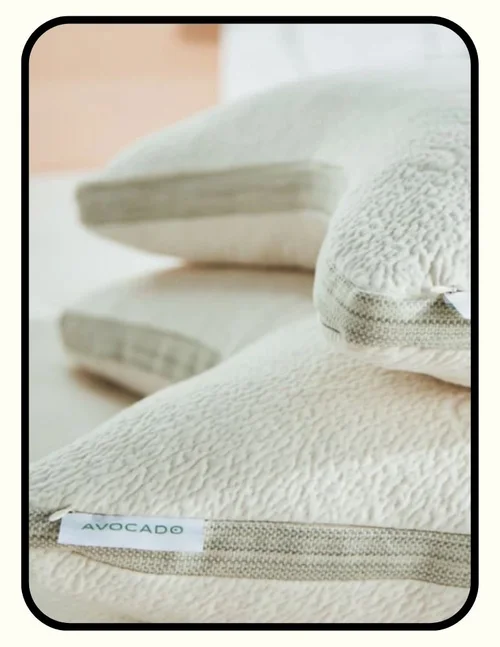 Avocado Organic Latex Pillow: Best Ergonomic Pillow for Side Sleepers
One of the few truly 100% organic pillows available, Avocado’s side sleeper pillow is filled with GOLS certified organic latex and GOTS certified cotton and fluffy kapok fiber in an adjustable, zippered design. You can choose between a traditional rectangular shape or an ergonomically curved option for enhanced neck support. Avocado’s complete transparency with certifications and ingredients makes them one of my top choices over and over again. I used this for years as a side sleeper and loved it over my previous non-organic pillow. (I’ve moved to Talalay but my husband, also a side sleeper, still prefers this.)
Product rating
See the rating scales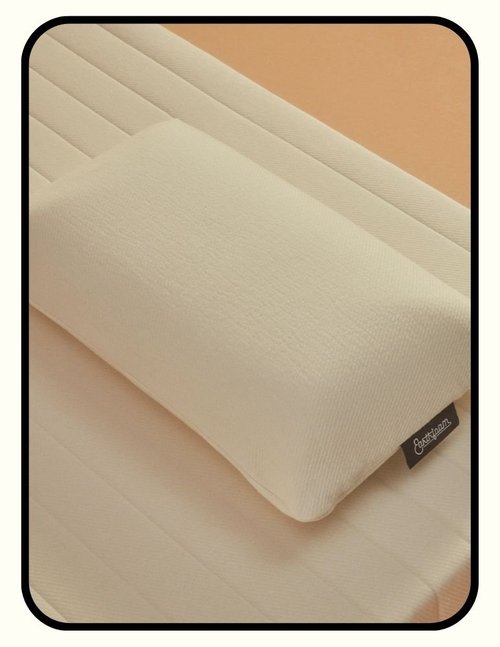 Earthfoam Natural Talalay Pillow: Best Soft Formed Latex for Side Sleepers
Earthfoam’s Talalay latex pillow is the best non-toxic pillow for side sleepers in my opinion! It gives you so much soft, springy neck support and as a side sleeper myself, I now use this pillow every night. Its squishiness is heavenly, and is just firm enough to align my shoulders and neck perfectly. Even after a year, I get happy when I flip sides and feel how nice it is. I wouldn’t recommend it you switch to back sleeping a lot— it’s fine for a bit, but gives a little too much pushback for all night. Made of formed Talalay latex, it’s softer than Dunlop latex. Importantly, Earthfoam’s Talalay is 100% natural without fillers, and is OEKO-TEX certified. I love it.
Product rating
See the rating scalesBest Non-Toxic Pillows for Back Sleepers
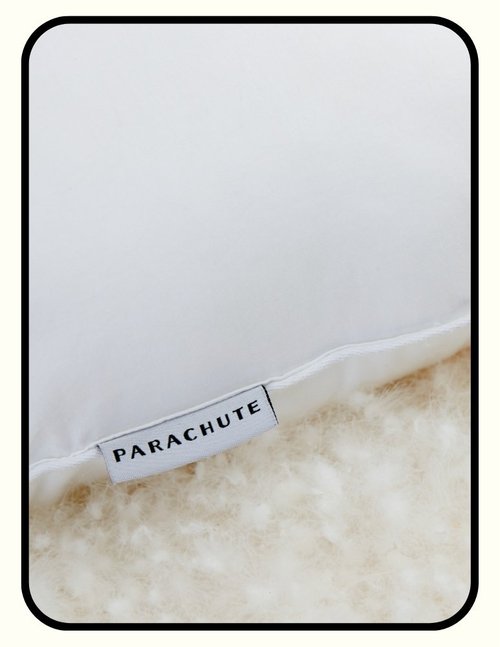 Parachute Down Pillow: Best Non-Toxic Down Pillow for Back Sleepers
Parachute’s super soft down pillows contain 85% down clusters and 15% feathers— a really nice ratio. Their medium fill is perfect if you’re a back sleeper who needs a compressible, yet supportive cloud-like pillow and likes the feel of down. The 100% cotton cover and fill are Class 1 OEKO-TEX certified meaning they’ve been tested for chemicals and meet strict limits, important for any fabric, especially one you’re close to all night. The down is certified humane for ethical sourcing as well. Firm is better if you switch to your side sometimes, and soft fill can even work for stomach sleeping.
Product rating
See the rating scales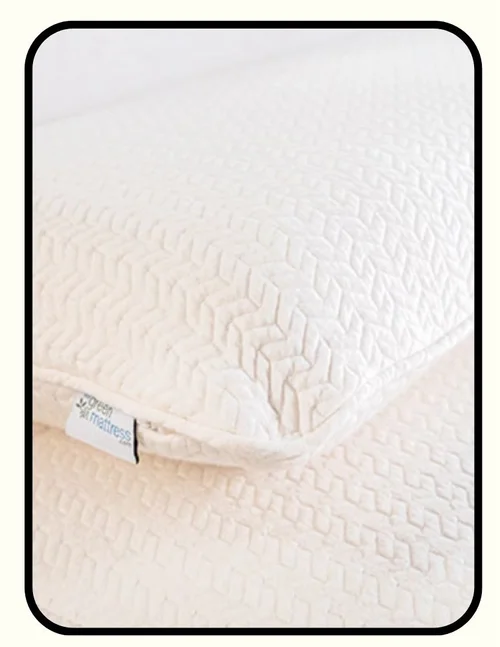 My Green Mattress Organic Dunlop Latex Pillow: Best 100% Organic Pillow for Back Sleepers
This pillow is made with GOLS certified latex that is blended with activated charcoal before its shaped— a mineral that helps reduce odors and moisture. These are not only ideal if you’re a back sleeper that needs that firm-yet-comfy, consistent support, but also: they’re really affordably priced! Dunlop latex is better than Talalay for back sleeping because it provides soft, stable support without excessive spring or the pushback that Talalay gives, which is another reason I recommend these. The molded design offers a non-toxic alternative to memory foam. Wrapped in GOTS-certified organic cotton.
Product rating
See the rating scalesBest Non-Toxic Pillows for Stomach Sleepers
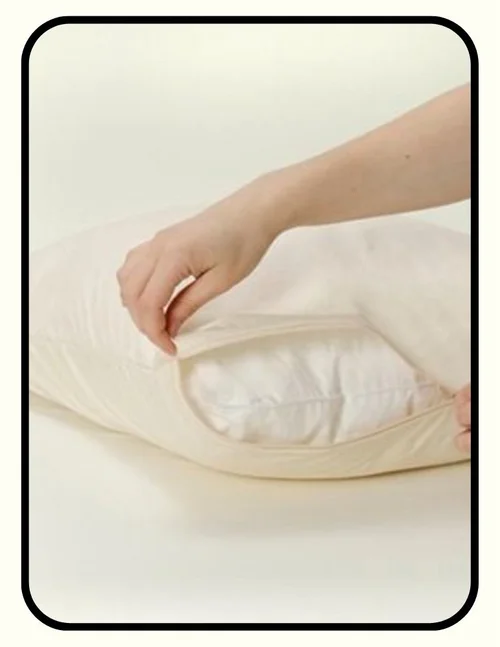 Most Important Pillow Tool for Allergies: An OEKO TEX Certified 1 Micron Weave Encasement
If you wake up sneezing or congested, you might be one of the 20 million Americans that are allergic to dust mites. Dust mites love pillows, because they’re sources of moisture and dead skin cells, their food. Or, you may also be allergic to mold, or may not know exactly. No matter what your reason for sneezing is, a zippered pillow encasement made of non-woven 1 micron fabric is the best addition to your pillow. The 1 micron weave size is important because it means it’s tight enough to block out fragments of dust mites, dust mite feces, and the smallest mold spores, all of which can easily pass through looser weaves (usually 4-10 microns) common in organic encasements. While these aren’t organic, they work better, and are made of OEKO TEX certified polyester. I’ve used these for years (I have one on every single pillow, mattress, and even some couch cushions in my house— photo above of me zipping one in.) They’re inexpensive, effective, soft, unnoticeable, and machine washable.
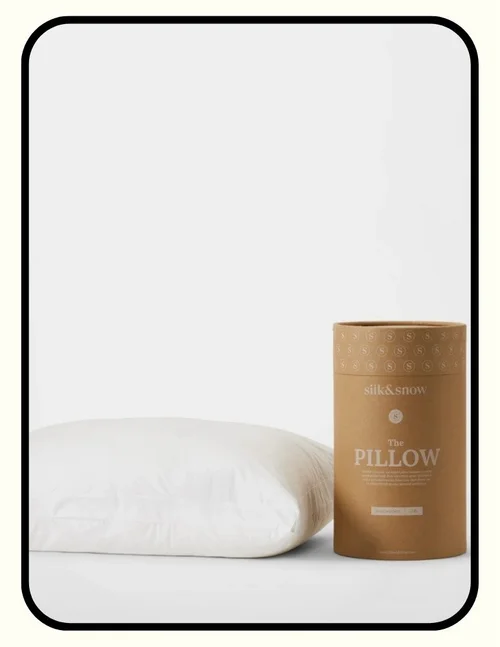 Silk and Snow Adjustable Pillow: Best Lower-Tox Pillow for Allergies
If you know you’re allergic to a particular ingredient, like wool, latex, or down, choose a different organic pillow made of a material that you’re not allergic to. Or, if you just sneeze and aren’t sure, try an encasement first. But, if you have severe allergies, and don’t want to mess around, choosing synthetics can be really helpful. This one by Silk and Snow is nice because it works for every type of sleeper — back, side, stomach, or combination — because it’s adjustable. It’s filled with CertiPUR memory foam, and OEKO TEX certified polyester fiber, with a 100% cotton cover. While I don’t normally recommend foam, and am cautious about synthetics, this is a case where protecting yourself from allergies and choosing imperfect, better options makes sense.
Product rating
See the rating scales Naturepedic PLA Pillow: Best Low Tox Pillow for Stomach Sleepers
PLA is short for polylactic acid, and is derived from fermented plant starch like sugarcane or corn. It’s similar in feel to polyester, but made from plants instead of petroleum. It’s soft and compressible, so it’s perfect if you don’t want that loft or pushback that many pillows give, or if you are a dedicated stomach sleeper. It still adds a touch of cushioning for support— it actually feels really similar to down in that way. Naturepedic’s PLA has OEKO TEX certification, meaning it’s been tested for chemicals and meets strict limits. It has a GOTS certified organic cotton cover, as well. Last, PLA is a good choice if you are vegan or have allergies to wool, latex, or down.
Product rating
See the rating scales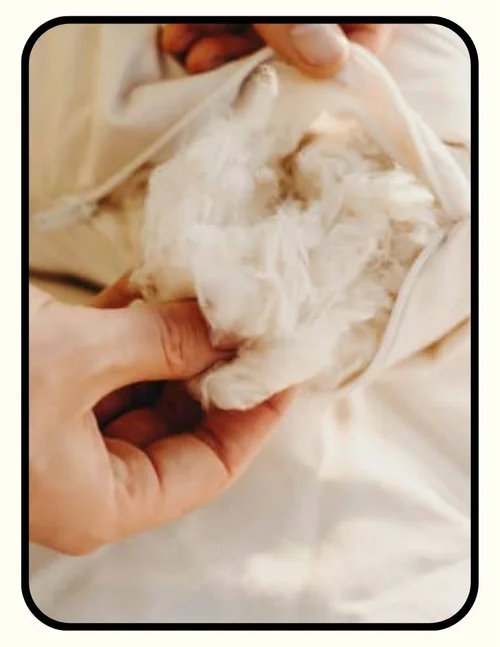 Savvy Rest Organic Kapok Pillow: Best Soft Adjustable Pillow for Stomach Sleepers
Savvy Rest’s most popular pillow is stuffed entirely with kapok fiber from kapok tree pods. Kapok is a super soft, compressible organic alternative to down. Since it’s entirely plant-based, this is also a great organic vegan pillow. Kapok is naturally moisture-wicking and quick-drying, keeping you cool and comfortable throughout the night. The adjustable design lets you remove kapok to achieve the low loft you need if you’re a stomach sleeper for proper neck alignment. This fluffable pillow earns consistently great reviews for being cloud-like and compresses easily without being toooo flat.
Product rating
See the rating scalesBest Non-Toxic Pillows for Allergies
Best Non-Toxic Pillows for Other Medical Conditions
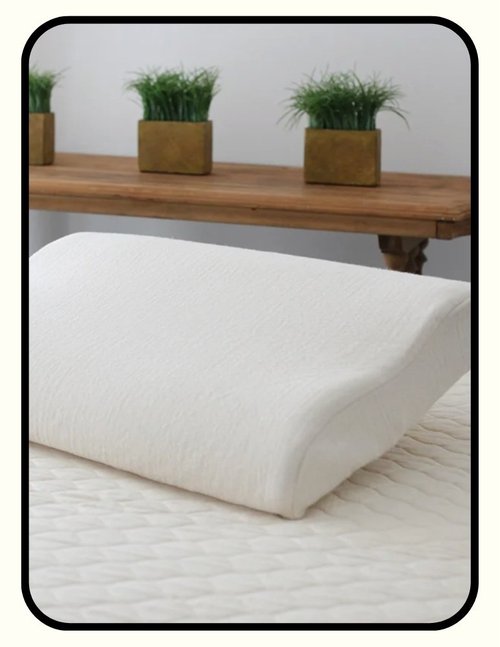 Savvy Rest Organic Latex Contour Pillow: Best Pillow for TMJ
Doctors specializing in TMJ disorder (TMD) often recommend sleeping on your back with a pillow that supports the natural curve of your cervical spine (your neck area). This helps relieve pressure on the tiny muscles of your jaw joint, allowing them to fully relax. While memory foam is often the standard guidance because of its supportive nature, I recommend organic latex, which has the same supportive qualities without the VOCs or other mysterious chemical additives. Savvy Rest uses organic medium Dunlop latex (not firm, so it still conforms to your neck) with GOLS certification and an organic GOTS certified cotton casing. It has a gentle neck curve to encourage that proper alignment. This isn’t medical advice. TMJ has many causes, and the right sleep setup varies person to person: check with your dentist or doctor before making changes based on your symptoms.
Product rating
See the rating scales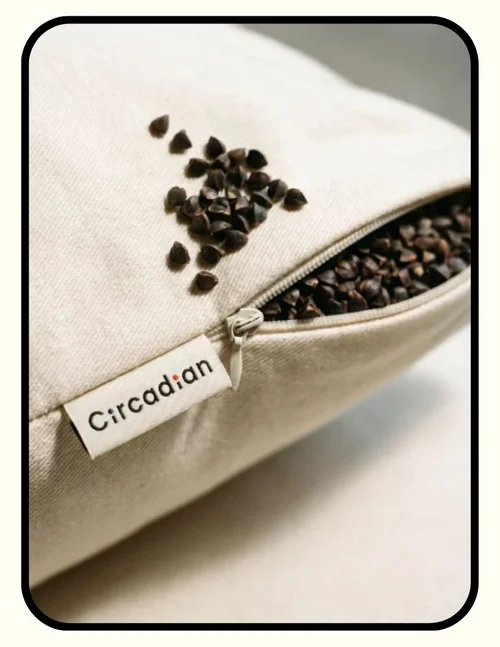 Circadian Rest Organic Buckwheat Pillow: Best Pillow for Neck Pain
Unlike TMJ, which tends to be chronic and responds best to one strict setup, neck pain is variable and doesn’t lock you into a single position or contour. The goal is a pillow that’s highly supportive but also adaptable, so you can fine-tune the height and firmness to your own neck. This is what buckwheat is so good at! If you don’t know already, buckwheat hulls move around, then interlock and hold position all night instead of collapsing. The fill is adjustable, and air moves freely between them, staying very cool. They’re heavy and won’t give you a soft, sink-in feel— which is generally fine during bouts of neck pain, or for some sleepers, who love them year round. Circadian’s organic cotton cover carries GOTS certification, and the USA-grown hulls are pre-polished and UV-sterilized with no chemicals. This isn’t medical advice: neck pain has many causes, so if yours is persistent or severe, ask your doctor what’s best for you.
Product rating
See the rating scales Best Non-Toxic and Organic Pillows for Pregnancy
The best body pillows and pregnancy pillows made with non-toxic and organic ingredients are all listed here on my Body Pillows page.
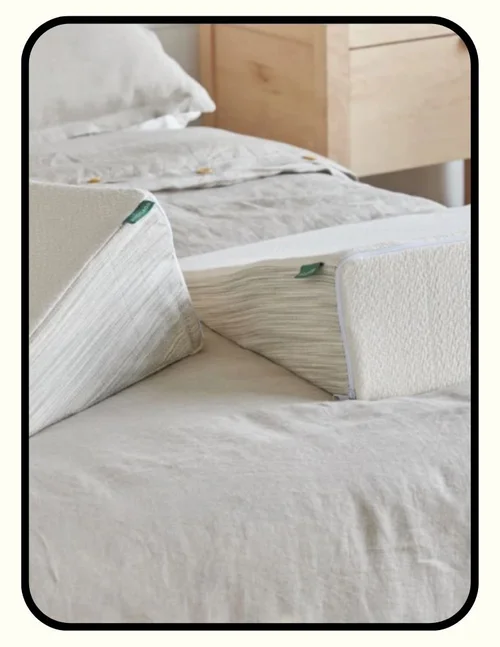 Avocado Organic Latex Wedge Pillow: Best Pillow for Acid Reflux
Gastroenterologists generally recommend keeping your head, neck and chest elevated to prevent acid from refluxing into your esophagus and causing damage while you sleep. They also prefer wedge pillows that have a natural rise, instead of stacking standard pillows, which can stack at an unnatural angle and contribute to neck strain. A pillow rising to 6-12 inches is best, and while memory foam is popular for its support, I prefer organic latex, which eliminates your exposure to the VOCs and other added chemicals in polyurethane foam. Avocado has the best wedge pillow for acid reflux because not only is it GOLS certified organic, it also has a removable organic cotton cover and an optional pillow protector to keep moisture out. It comes in two heights, 7” and 10”, right in the recommended range. As always, this is not medical advice: if you have acid reflux, ask your doctor what is best for you.
Product rating
See the rating scalesLooking for something specific? If you don't see the product or brand you're curious about, you can request a review here, or run it through the Second Opinion Product Checker to evaluate it yourself. Want to go deeper? My free course covers how to evaluate any product's materials yourself.
Join the Newsletter
Join the Newsletter
More Healthy Design For You


Organic Pillowcases
The Complete Guide to Organic Pillows: Certifications, Materials & How to Choose
Table of Contents
How Interior Medicine rates pillows
How to find the best non toxic pillow for your sleep position
Pillows and allergies: latex, dust mites, waking up congested
How Interior Medicine Rates Pillows
The rating symbols you see below each non-toxic or organic pillow represent my analysis of every material layer, using the same objective scales for each one. I do this to make things visually easy for you, and to ensure I stay neutral and unbiased by using consistent methods for each brand. I also like being transparent about every affiliate relationship I have, since most non-toxic product round-ups do not disclose which companies they make a commission from, so can be incentivized to rate pillows as healthier than they actually are.
You can see all the detail that goes into each rating symbol by looking at my Foam Guide and Fabric Guide. If you don’t want to do a deep dive, a simplified overview of the ratings are:
Foam: GOLS certified organic Dunlop latex > natural latex > CertiPUR polyurethane foam
Fabric: GOTS certified organic fibers > uncertified natural fibers > semi-synthetics > synthetics with harmful additives
I rate pillows strictly on material health, but mention things like cost and functionality in the description.
Are organic pillows worth it?
An emphatic yes. I recommend them as the first upgrade to make in your home for 4 reasons.
Material Health: Your pillow is the object you're in the closest contact with in your entire house—even your toothbrush you only spend a few minutes with every day. Meanwhile, your pillow is snuggled right up against your face for one third of your life, including your nose and mouth, which lead directly to both your airway and gut. With constant skin contact as well, the materials it's made of have a huge impact on your health. Conventional polyurethane foam pillows off-gas VOCs and contain chemical flame retardants that can be inhaled, ingested through dust particles, or absorbed through your skin. Since many of these chemicals are bioaccumulative, reducing exposure where you spend 7-9 hours per night makes practical sense. Foam exposure adds up throughout your day—your car seats, office chair, couch, and gym equipment all contain foam with chemical additives. Starting with your pillow, one place you have control over, makes sense.
Affordability and Longevity: Organic pillows can last longer than conventional ones. Latex is more durable than polyurethane foam, for example. And, even a top of the line organic pillow runs around $200, with other options running in the double digits, making them an accessible way to start making an impact on your health. You get more health benefit per dollar spent with a pillow than any other item in your home, including mattresses, given the ultra-close contact.
Sleep Benefits: Healthy sleep underpins every other aspect of your health—your immune system, your mood, your metabolism, your memory. A pillow that helps you sleep cooler, breathe cleaner, and rest more comfortably is foundational to every other aspect of your life.
Allergen Reduction: 20 million people in the US are allergic to dust mites, and many people who wake up congested, sneezing, or groggy never connect it to their pillow at all. Dust mites thrive in pillows because pillows offer everything they need: warmth, moisture from your breath and skin, and a steady supply of the dead skin cells they feed on. Over time, an old conventional pillow can harbor a significant population of mites, along with their droppings, which are the actual allergen that triggers symptoms. Many natural fills—wool, latex, and kapok —are naturally moisture-wicking and resistant to the damp environment dust mites need to flourish, so they're inhospitable to mites in a way that conventional foam isn’t. Wool in particular regulates moisture so well that it stays too dry for mites to settle in.
Safest Materials for Pillows
What are the safest materials for pillows?
The safest pillow materials are those with minimal chemical processing, meaning low VOC emissions (that “memory foam” smell) and low sVOC release, too. sVOCs are chemical additives like flame retardants, which don’t volatilize into your bedroom air, but fall out of foam over time.
The healthiest pillow materials are natural or organic, but even more importantly, the healthiest pillows will have third party certification ensuring that the materials are what they say they are. Look for:
GOLS-certified organic latex (GOLS) or 100% natural Talalay latex with certification
GOTS certified organic wool, cotton, or kapok
OEKO TEX -certified wool, cotton, kapok
OEKO TEX -certified semi-synthetics like Tencel eucalyptus or even bamboo
OEKO TEX -certified polyester is a better choice than standard
Buckwheat hulls: these don’t have any applicable third party certifications, so ask the brand how they’re processed.
Certified materials don’t have the flame-retardant chemicals, polyurethane foam blowing agents, and antimicrobial finishes common in conventional pillows. A natural fiber like cotton with standard processing can have all of these added, making it an unhealthy choice in the end. Confirm the seller can produce the certificate on request! I consider a material claim without documentation to be healthwashing.
Are bamboo pillows non-toxic?
Some can be, but the word "bamboo" tells you almost nothing about safety. Most "bamboo" pillows are made from bamboo viscose (rayon), a fiber produced by dissolving bamboo cellulose in a chemical-intensive process using carbon disulfide and sodium hydroxide. The finished fiber can still be safe if the residual chemicals are removed and the product is certified, but the raw plant being bamboo does not make the pillow non-toxic.
Two things determine whether a bamboo pillow is non-toxic:
First, what is actually inside it: many bamboo pillows have a thin bamboo-viscose cover over a shredded polyurethane memory foam fill.
Second, whether the seller holds current OEKO-TEX Standard 100 (or comparable certification) and will show it to you. A verifiable certificate is the deciding factor.
Fun fact: the largest greenwashing penalty the FTC has ever issued was for “bamboo” textiles. It was for $5.5 million against Kohl's and Walmart in 2022. The FTC found that both labeled rayon as "bamboo" and made "non-toxic" and "eco-friendly" claims about products actually made with toxic chemicals.
Are Cozy Earth pillows non-toxic?
Not in my opinion, no. When I asked Cozy Earth for their OEKO-TEX certificate, they told me it was proprietary information. I can’t find it in the OEKO TEX lookup, either, though sometimes that’s because they use a different name for the business than their public-facing one. A secret certificate is difficult to distinguish from a certificate that does not exist, and OEKO-TEX certificates are not confidential documents by design. That response left me unconvinced their bamboo is certified or as healthy as the marketing claims. I treat the claim as unverified.
How to Choose the Best Organic Pillow
How do I choose an organic pillow for my sleep position?
The best organic pillow depends on your sleeping position and personal preferences. Here's how to find yours:
Step 1: Check for certifications. Look for GOTS and GOLS certifications to ensure it's truly organic, not just "natural" or healthwashed. OEKO-TEX is also a useful certification ensuring lower chemical processing. You can take a deep dive into certifications for pillow materials in my Foam Guide and Fabric Guide, or just remember GOLS, GOTS, and OEKO TEX are best.
Step 2: Match material to your sleeping position
Combo sleepers: Need good support for sleeping on side, back, or stomach, so finding an adjustable height pillow, a pillow that is made specifically with different sections for different positions, or one that has a well-rounded support and sink-in feeling all in one. See my recommendations at the top of this guide.
Side sleepers: Need high loft and firm support to keep your neck, shoulders, and spine in alignment. Choose organic latex or adjustable wool pillows that can be customized for proper spinal alignment. If you know you like a higher amount of springy support, choose a formed Talalay latex pillow.
Back sleepers: Need medium loft and medium firmness. Opt for Dunlop latex or adjustable Merino wool that supports your neck without excessive pushback or height.
Stomach sleepers: Need low loft and soft, compressible materials. Choose organic kapok or down that can flatten without straining your neck. PLA is a semi-natural fiber made from sugarcane that feels and acts a bit like down, and can also be a good choice.
Step 3: Consider your other preferences. Beyond position, think about whether you sleep hot (choose wool or latex), have allergies (latex and wool are naturally resistant to dust mites and excess moisture build up), or want adjustability (shredded latex or kapok).
Pillows and Allergies
Are organic pillows good for allergies?
Yes, organic pillows are good for allergies and asthma for three reasons:
Less susceptible to dust mites: Latex, wool, and cotton are more breathable and moisture-resistant than polyurethane foam and synthetic fabrics. You'll sweat less, and moisture evaporates more quickly. Since dust mites thrive on moisture, this reduces their numbers.
Dense structure: Latex is breathable but dense, creating fewer spaces for your skin cells (dust mites' food source) and allergens to accumulate.
No off-gassing: Allergies and asthma can be exacerbated by VOCs and off-gassing from standard polyurethane foam pillows.
Note: Organic pillows aren't dust mite proof, but they're significantly better than conventional foam pillows. If you have severe allergies, pair your organic pillow with an OEKO-TEX certified dust mite pillow encasement— the ones I use are woven to 1 micron, meaning not even dust mite particles or mold spores can pass through.
Can I sleep on a latex pillow if I have a latex allergy?
If you have a latex allergy, always follow your doctor’s recommendations about avoidance.
Generally, the thinking around latex pillows is that the latex proteins (which come from tree sap) have been baked into shape, so are inactive, and aren’t able to cause a reaction. Has this been tested? N.
It’s always possible that there are some residual active proteins, and it’s better to be safe than sorry. If you have a mild reaction you can always test a pillow first with caution. Otherwise, an adjustable wool pillow is the closest organic option, since it has good spring and can be used for side and back sleeping like latex can.
Why do I wake up congested? Why do I sneeze in the morning?
It’s possible you have an allergy to dust mites, which 20 million Americans do. Dust mites are microscopic pests that are present in and on just about every surface in the world that contains moisture and dead skin cells— their sources of food. This means they’re concentrated very highly in pillows, mattresses, couches, car seats, and other upholstered surfaces. Harmless to most people, if you have an allergy, they can cause you to sneeze, wake up congested, and even exacerbate asthma.
Using a pillow that is resistant to moisture build-up, thermoregulating, and dense is ideal. Formed latex is ideal, or wool. Use an encasement on your pillow that is woven to 1 micron or less. Dust mite fragments, their fecal matter, and their fecal matter fragments, all of which are allergenic, can be as small as 1-40 microns, so be sure to check the weave size for this reason. Once on your pillow, dust mites and their fragments have no way to enter or exit. Wash your pillowcases on as a hot a setting as possible. I have recommendations here.
Do organic pillows sleep hot?
No, most organic pillow materials sleep cooler than conventional memory foam. Here's why:
Wool: Naturally thermoregulating and moisture-wicking, drawing heat and sweat away from you
Latex: More breathable than memory foam and doesn't retain as much body heat
Kapok: Moisture-wicking and quick-drying
Organic cotton and other natural fiber pillow encasements and outer covers: More breathable than polyester covers
Memory foam is notorious for sleeping hot because it traps body heat. Organic materials like wool and latex actively regulate temperature, making them excellent choices for hot sleepers seeking non-toxic options.
Do organic pillows smell?
Yes, but not in a bad way, and the smell is not harmful. Not all VOCs or smells are toxic—for example, trees, flowers, and essential oils produce healthy VOCs.
Latex (which comes from the Hevea brasiliensis tree sap) has a mild smell that dissipates over time. It's not off-gassing synthetic chemicals like polyurethane foam pillows do. I personally think it smells faintly fruity or like vanilla. I noticed it more with larger latex items and less with pillows, which are smaller.
Wool and kapok may also have mild natural odors when new, but these fade quickly and aren't harmful. Unlike conventional foam pillows that off-gas synthetic VOCs for at least a year, organic pillow odors are natural and temporary.
Pillow Needs
Is sleeping without a pillow good for you?
It can be, if you do it right, and it depends on your sleep position.
Sleeping without a pillow tends to work best for stomach sleepers, because a flat surface keeps the neck closer to a neutral angle instead of cranking it upward.
For back and side sleepers it usually creates problems: without support, the head drops back or the neck bends sideways, straining the cervical spine and surrounding muscles.
The goal of any pillow setup is keeping the head and neck aligned with the spine. If going pillow-less throws that alignment off, it works against you. If you are a stomach sleeper or transitioning to one, it can reduce neck strain.
Why do humans needs pillows?
Necks, mostly. When you lie down, there is a gap between your head and the mattress created by the natural curve of the cervical spine. For side sleepers, the gap is made by the width of your shoulder. A pillow fills that gap so the neck stays in a neutral position instead of bending to reach the mattress. Without support, muscles and ligaments in the neck hold that bend all night, which is what causes morning stiffness and pain.
Why are pillows important?
Pillows matter because they protect the neck and shoulders during the roughly one-third of your life spent sleeping. The right pillow keeps your cervical spine aligned with the rest of your back, which reduces muscle strain, nerve compression, and morning pain. For side sleepers especially, a pillow of the correct height fills the shoulder-to-head gap and keeps the spine straight rather than kinked.