
Non Toxic Weights
The safest plastic-free hand weights for your home gym are made of bare or chrome-plated steel, solid wood, or iron coated in silicone or TPU. These materials avoid the plasticizers, chlorine, and additives found in typical PVC, neoprene, and recycled rubber dumbbells. A Prop 65 warning isn’t actually always a reliable way to judge non toxic weights, since many metals carry a label for metallic dust risks to factory workers, even though finished metal is one of the safest weight materials (read more in my Prop 65 guide). Instead, I rate each material on its own, including any finishes, using the same methodology for every product.
By Dr. Meg Christensen | Physician-founder of Interior Medicine, a non-toxic home resource built on her background in medicine, biochemistry, epidemiology, and clinical research.

Updated October 21, 2026
Steel and Wood Hand Weights
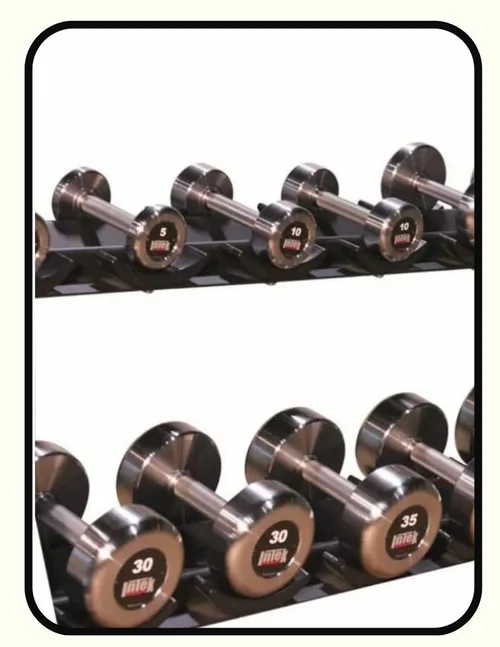 Intek Strength Kraft Uncoated 100% Steel Hand Weights
Many metal hand weights have an undisclosed clear finish on them. These are generally cured on, making them relatively inert and non-toxic, and that means they also won’t off-gas nearly as much as a neoprene or PVC weight encasement would. That said, I understand the impulse to find something totally pure and not worry about it at all. This brand’s hand weights are made of 100% stainless steel without a coating, or any plastic, neoprene, PVC, or synthetic rubber. A straightforward, practical, and healthy choice if purist steel is your style.
Product rating
See the rating scales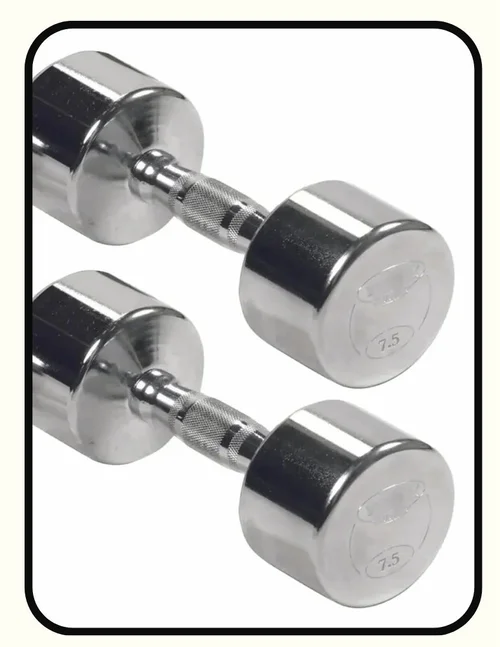 Amazon Affordable Steel Chrome Plated Dumbbells
Chrome plated steel is actually a very safe choice in terms of coatings for hand weights. Once plated onto steel, the finished chrome surface is metallic chromium 0, which is inert. Amazon has a ton of chrome-plated steel hand weights at reasonable prices. I linked one example, but no brand is necessarily better than another when the materials are the same. If a metal hand weight that you like has a Prop 65 label on it, don’t automatically reject it; look into why. Often it turns out the listed chemical is nickel or chromium, which, like wood dust or any fine particle, are hazards as dusts inhaled during manufacturing, not from holding a finished weight. Many brands add the warning defensively to avoid lawsuits. Read more in my Metal Guide and my Prop 65 guide.
Product rating
See the rating scales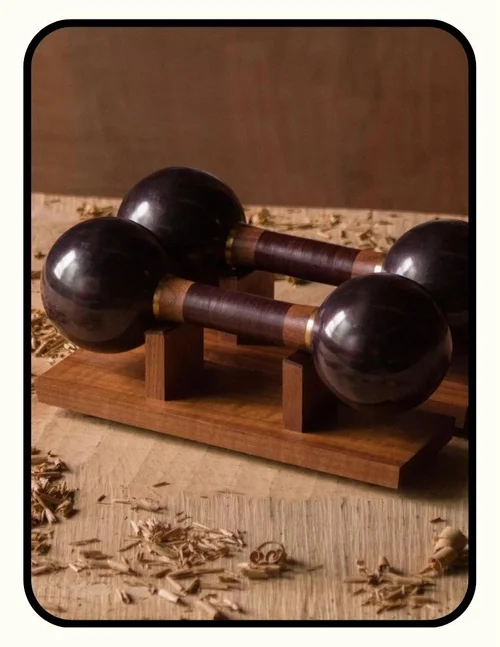 Non Toxic Wood and Metal Weights on Etsy
There are a surprising number of luxury handmade wood and metal dumbbell sets, some for $20,000+. In case that’s out of your budget (lol), I recommend Etsy. Etsy has an incredible number of handmade wood and metal weights at a variety of price points, and most of them are customizable. The Mallet weights pictured above, by HEFT Designs, are incredibly beautiful and made of iron, wood, leather and brass. The nice thing about Etsy is that you can ask the maker directly what materials, finishes, and glues they use, and often you can make custom orders that meet your standard of material health. The primary thing you’re looking for in a handmade non-toxic hand weight is what finishes and glues are used on it. Otherwise, the steel and solid wood are going to be completely healthy choices. Final ratings depend on the maker.
Product rating
See the rating scales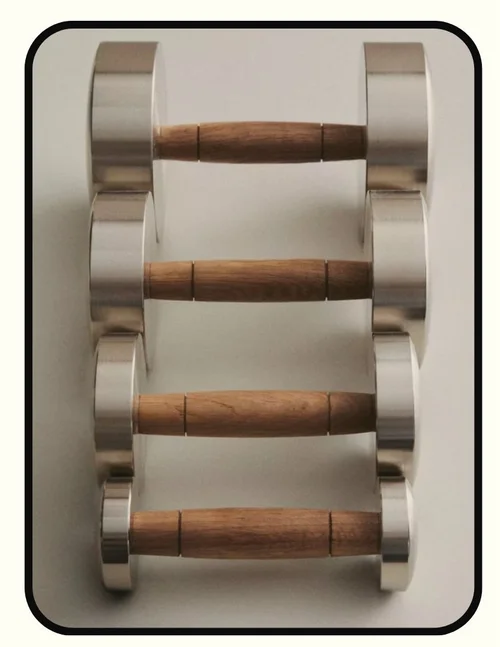 Zara Home Wood and Stainless Steel Hand Weights
While Zara Home wouldn’t tell me what type of finish, if any, is used on the oak portion of their dumbbells, they are still truly made of solid oak and steel, making them plastic-free hand weights. I also couldn’t get information on whether or not they use glues, but in general, these would be unlikely to add much of a VOC load into your home gym. Even without full transparency, I appreciate the trend toward natural materials like wood, metal, and leather, instead of foam and plastic and consider these a major step in the right direction. Like what you find on Etsy, these are a bit more affordable than the highest end varieties and still look nice.
Product rating
See the rating scalesNon-Toxic Silicone & TPU Weights
 Lifted Movement Steel, Marble and Silicone Weights
These hand weights are very beautiful and made of powder-coated steel and marble, with a silicone grip on the lighter weights. (The heavier ones have an etched stainless steel grip.) They also have a few storage systems that are likewise made of natural materials like wood and steel. An investment, but a very healthy choice.
Product rating
See the rating scales Bala Silicone Weights
Is Bala non toxic? Yes. Read more about why I consider silicone weights non toxic and safer than neoprene, PVC or urethane weights in my FAQ below. Bala makes the widest variety of non toxic weights for your home gym including bars, silicone wrist weight bangles, kettlebells, beams, and rings.
Product rating
See the rating scales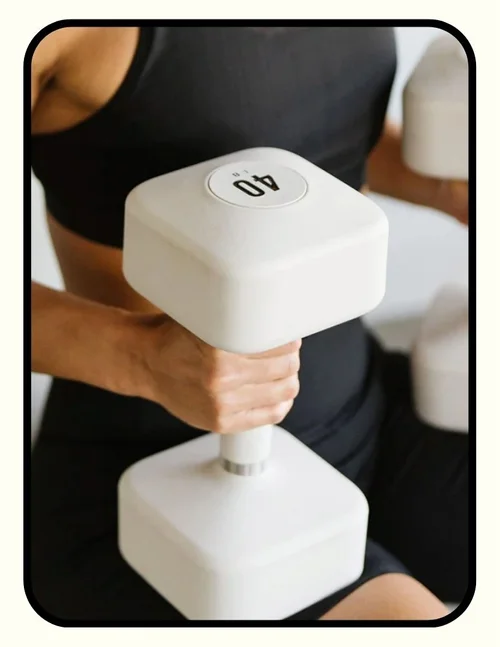 WeGym ProGrip TPU Coated Weights
TPU is almost as straightforward as silicone in terms of material health for hand weights. It’s a big step above neoprene, PVC, most urethane, and recycled tire rubber; read more details in my FAQ below. WeGym’s ProGrip dumbbells have an iron core and a TPU coating. (Their SafeGrip ones are not the same; those are coated in PVC.) But the ProGrip line is relatively affordable, their sets come in a satisfying range of weights, and I think the fact they’re made of TPU strikes a nice balance between durability, aesthetics and non-toxicity.
Product rating
See the rating scales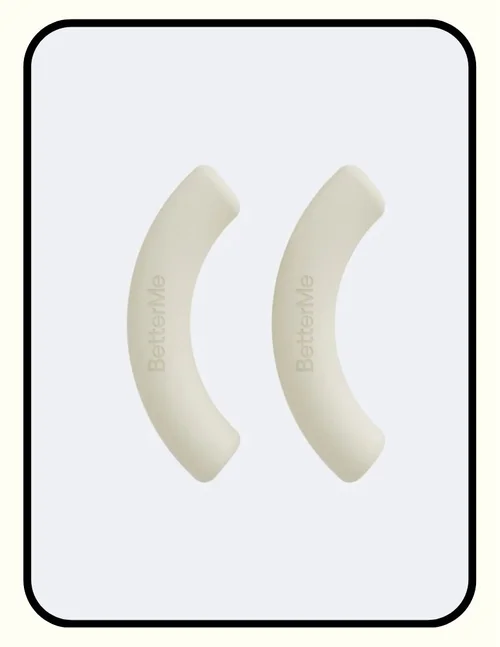 BetterMe Silicone Dumbbells
Is BetterMe non-toxic? Some of their equipment is. They offer 2.2 lb silicone dumbbells and silicone-covered iron ankle weights along with lots of other home gym gear. While some of their other equipment is made of PVC and other plastics I’m not a huge fan of, I appreciate how transparent they are about their materials, which are listed on every product page. I think their dumbbells and ankle weights are a good non-toxic choice.
Product rating
See the rating scalesDon’t see what you’re looking for? Request a review, or check it yourself in seconds with the Second Opinion Product Checker. Spot something outdated? Let me know and I’ll update it. Join the spam-free newsletter for interesting info and to hear when new reviews are up.
FYI, “non-toxic” has no official definition, so I rate every product with the same method. It’s built on third-party certifications and published test data, not brand claims. For a deeper dive, my free course walks you through it.
Everything on Interior Medicine is educational information, not medical advice. Read my full disclaimer.
More Healthy Design For You

How Interior Medicine Rates Dumbbells and Hand Weights
"Non-toxic" has no legal or scientific definition, so it's become a marketing word. I still think a healthier home is worth working toward, and the way to get there is with a consistent system. Every product on Interior Medicine is rated with the same method, based on its materials, ingredients, and third-party certifications. This makes it easier to compare products fairly, spot healthwashing, and make informed decisions.
The rating card under each product shows its Material Health. Every material is rated on its own scale, from Healthiest to Harmful, and each brand is rated on the healthiest option it offers. Differences between models are noted in the description.
The guides show what qualifies for each tier, what to look for, and what to ask a brand.
More About Non Toxic Dumbbells for Home Gym
Are silicone weights non toxic?
The short answer is yes.
The main concern with silicone is cyclic siloxanes (D4, D5, D6), which are leftover molecules from manufacturing that can off-gas into air, especially when heated, or migrate into food. Release is highest when silicone is new, heated, or in contact with fatty foods. So silicone bakeware and food contact items definitely deserve scrutiny, and you should look for certifications that show low leaching like LFGB. Read more in the silicone section of my Plastic Guide.
But silicone weights are very low risk: you’re touching solid silicone at room temperature. There is actually some indirect research on it! When pure D4 and D5 (the most concerning part of silicone) are applied directly to skin, lab studies show they can move into skin layers. But very little does, and when it happens, under 0.5% actually gets fully absorbed through all layers of the skin to reach the bloodstream. In general, researchers have found that inhaled siloxanes, like what happens when you bake with silicone the first few times, are more of a concern. Cured, solid silicone you’re touching is completely different. It’s not liquid siloxanes being applied directly to your skin, and silicone weights are not being baked and heated in your oven. (No study has measured non-food use like hand weights directly.) Exposure route matters! Consider my free course for more ;)
Silicone is naturally flexible, so doesn’t require plasticizers or BPA. Unlike PVC or neoprene (other common plastics used on weights) it also doesn’t require chlorine or urea accelerators. It’s relatively chemically stable, heat resistant, and leach resistant. It’s not perfect; it does still contain processing aids and pigments. But as far as plastics go, silicone is the safest choice.
Are TPU hand weights non toxic?
They’re better than most plastics used on weights. TPU (thermoplastic polyurethane) is inherently flexible, so it doesn’t need plasticizers, and doesn’t need some of the harmful additives that PVC or neoprene require for processing. As always, there are undisclosed processing agents. In general, as far as plastics go, I am a fan of TPU, especially plant-based TPU. It’s ideal in waterproofing applications like mattress protectors and crib mattresses where preventing mold and bacterial mold up is important. TPU is a relatively inert and non-toxic way to do that, with near-zero off-gassing. It’s even accepted as an accessory material by GOTS, the strictest standard in organic fabric certifications.
When TPU is applied to weights, it’s slightly less necessary than waterproofing, but can provide a comfortable grip that’s healthier than standard PVC or neoprene.
Are urethane hand weights non toxic?
Modern urethane weights might be healthier than PVC, neoprene, or recycled tire rubber, but there is more inherent mystery to urethane than TPU or silicone, and more potential for harmful processing additives. I would avoid them in most cases.
Urethane weights have a shiny clear plastic appearance that’s quite cute: they’re often called jelly bells. But, urethane requires a curative called MOCA that is classified as a Group 1 carcinogen by IARC. Most of it will be fully reacted and not able to reach you by the time you touch it, and it’s mostly an issue for workers coming into contact with it. It’s possible that there is some residual left behind. Mercury is another issue; this was used as a catalyst in polyurethane for decades and was banned for this use in the EU in 2017. The US still hasn’t banned it and it is also possible that it’s used in cheaper imports. That said, states have restrictions, and in 2012, Dow Chemical started using replacements for it.
What are hand weights usually covered in?
Most standard hand weights for home are steel covered in PVC, neoprene, styrene-butadiene rubber, or urethane without disclosures. Most of these plastic coatings require plasticizers to make them soft and flexible, and sometimes have other additives including heavy metals that act as stabilizers in colorful hand weights. The plastic also often has some off-gassing associated with it, as well, which is why people are making the switch to safer alternatives.
Why do hand weights off-gas?
If a dumbbell has rubbery-looking ends and a strong smell, it’s probably made with synthetic rubber or recycled tire rubber.
Recycled tire rubber smells the strongest. Most of that smell comes from sulfur compounds left over from the process that hardens rubber, along with other VOCs (volatile organic compounds). The smell usually fades within a few weeks to months.
Tire rubber also contains PAHs (polycyclic aromatic hydrocarbons). These come from the black pigment and oils used to make tires. Some PAHs are linked to cancer. A few can off-gas into the air, but most stay in the rubber and can rub off onto your hands over time. The EU limits PAHs in rubber that touches skin, including sports equipment. The US has no similar limit.
New (virgin) synthetic rubber smells less and has fewer PAHs than recycled tire rubber.
What is neoprene on hand weights?
Neoprene is polychloroprene, a type of synthetic rubber. It’s made from liquid chloroprene, a petroleum-derived chemical, and is the same material as what wetsuits and orthopedic braces are made out of. On dumbbells, it’s usually a textured, dipped coating over cast iron. Like with most plastics, the health considerations are mostly about what goes into making it flexible and rubbery. Neoprene is typically made with something called thiourea compounds. Using them speeds up the process of turning it into a rubbery plastic. These are well-documented contact allergens, which is where “neoprene allergy” from wetsuits and braces comes from. One type, ethylene thiourea, is also a reproductive toxicant according to the EU’s Substances of Very High Concern list, and that’s why weights sometimes have a Prop 65 label on them.
Is powder coating safe to touch?
It is very likely much safer than touching a receipt. I’m generally a huge fan of powder coated furniture like bed frames, TV stands, and cabinets. It’s affordable, doesn’t off-gas, and is usually held together with screws instead of glues.
Receipts are a useful comparison because you’re touching them, and receipts contain BPA, like some powder coats do. Epoxy and epoxy-polyester hybrids, do have some BPA in their resins, though usually under Prop 65 limits. Thermal receipt paper has BPA (or BPA alternatives) sitting loose on its surface, and it rubs off onto your fingers every time you touch it. On the other hand, powder coating goes on as a dry powder, then it’s baked until it melts and cures into a hard, continuous film. Curing locks most of that BPA into it instead of leaving it loose on the surface. Polyester powder coat, which is common on furniture, isn’t made with BPA at all.
For modern powder coating in good condition, touching it every day isn’t something I worry about, even when it contains some epoxy in the blend.