
Plastic Free Water Filters: Do Any Actually Work?
Most “plastic free” water filters still use plastic somewhere, usually in the filter cartridge. The ones that come closest to plastic free tend to have the weakest proof that they actually remove contaminants from tap water. As of 2026, the filters with the strongest proof they remove a wide range of contaminants, including microplastics, all still contain some plastic.
Below are low and no plastic water filters, rated and ranked from most effective to least. Compare them to all types of drinking water filters and you’ll notice that, with a few exceptions, most land toward the bottom. Generally that’s OK: plastic leaches less into cool or room temperature water, and they remove important non-plastic things like pharmaceuticals and heavy metals. But if you’d rather buy less plastic, that’s a fair choice too; below shows you where to start. See how I score water filters in my methodology.
By Dr. Meg Christensen | Physician-founder of Interior Medicine, a non-toxic home resource built on her background in medicine, biochemistry, epidemiology, and clinical research.

Updated November 2, 2026
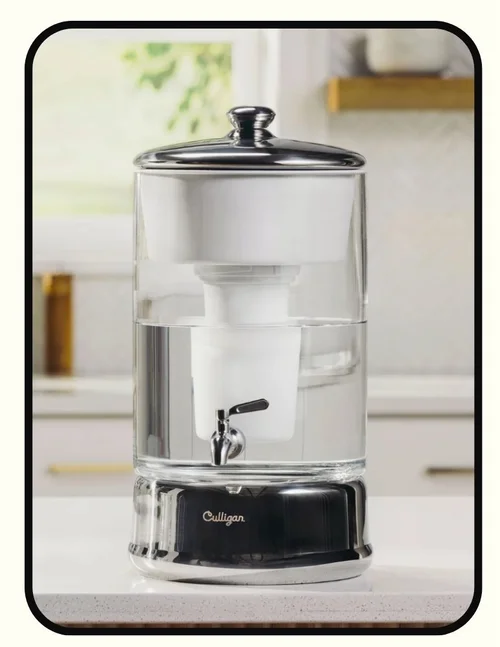 Culligan ZeroWater Glass Dispenser: Best Low Plastic Filter for PFAS
If PFAS are your biggest worry and you want less plastic in a water filter, this is the best water filter for you. Culligan’s ZeroWater filter fits a few different dispenser types, including their glass and stainless steel dispenser, pictured above. While the filter cartridge is still plastic, it’s still a good reduction. It’s NSF certified for 9 contaminant groups, and it’s certified through IAPMO for total PFAS: 7 of 7 removed. Most filters only test for 2, PFOA and PFOS, so that’s its main strength. The one weakness is capacity: each filter is only certified for 20 gallons, so you’ll need to replace them a lot more often than others.
Product rating
Compare all water filters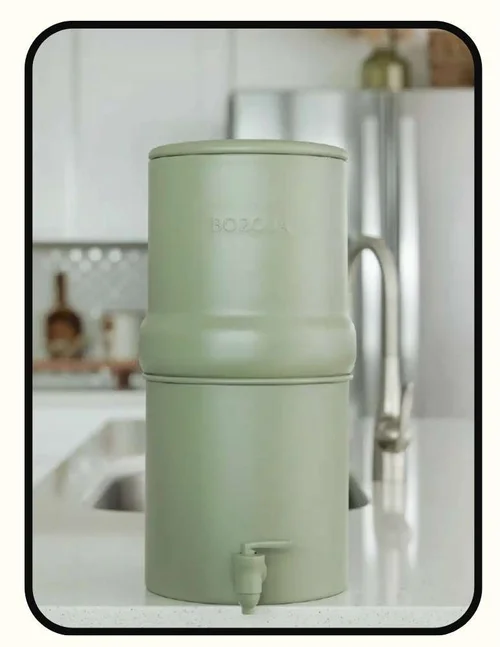 Boroux: Best Stainless Steel Gravity Water Filter
Boroux’s stainless steel gravity filter is really good at removing contaminants, and actually ends up high on the list of all water filters. It’s NSF 42 and 401 certified, and they also had one-time IAPMO lab testing done on a long list of water pollutants: all 7 PFAS, 30 of 30 VOCs, Rx and chemicals, and microplastics. That’s much more testing than most of its similarly designed gravity style competitors have. It comes in a few nice colors, and they offer a wooden floor stand that works if you want to get it off of your countertop, too.
Product rating
Compare all water filters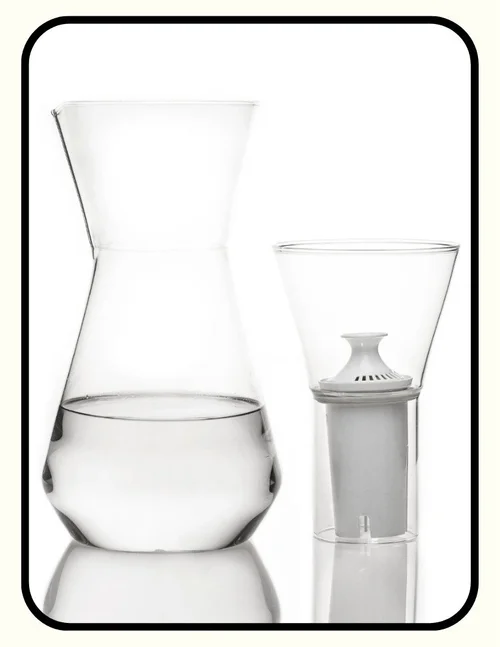 Brita Elite Filter in a Glass Carafe: Low Plastic Workaround
This glass carafe is expensive and beautiful but fits a Brita Elite filter perfectly. The Elite filter itself is certified for 6 contaminant groups over 120 gallons, which is quite a lot for a small and inexpensive filter. Cheaper glass pitchers that fit Brita filters are hard to find, so another option is to filter through Brita’s regular plastic pitcher, then store the water in your own glass pitcher. Plastic leaches more into warm or acidic liquids (think water bottles left in a hot car), so cold water will pick up much less. You still get the lead, mercury and cadmium removal, which arguably matters a lot more than the pitcher.
Product rating
Compare all water filters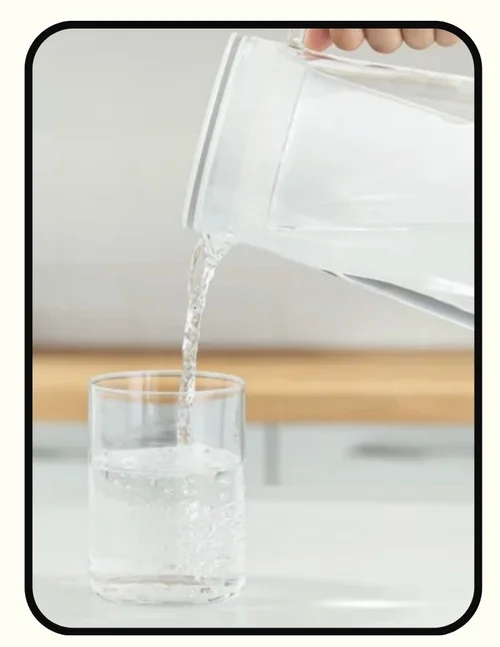 LifeStraw Glass Pitcher: Best Low Plastic Water Filter Pitcher
This is the best low plastic water filter pitcher. It’s mostly made of glass, with plastic only in the top where the filters and unfiltered water are held (and it has a silicone base). Anything that touches your purified water is glass. It uses two filters: a carbon/ion-exchange filter you replace every 40 gallons, and a microfilter that lasts 264 gallons. It’s NSF certified and has independent lab testing for microplastics, which a lot of plastic-free options ironically don’t have.
Product rating
Compare all water filters Duryn Water Filter Review
Does the Duryn water filter work? It might for a few gallons, but the testing and marketing is misleading. For example, they say PFAS were removed at about 99% efficiency, but scroll through the actual test report data and you’ll see that testing stopped at 35 liters (about 9 gallons) because the water flow slowed so dramatically. So yes, it can remove PFAS, but maybe only for 9 gallons. Likewise, it can remove some heavy metals, but was only tested for 39 gallons, had a slow flow rate, and most results aren’t displayed for most metals. I’m so bummed to see this because the design is beautiful! But this is exactly the kind of test data that tricks people into thinking their water filter is doing more or lasting longer than it actually is. If you are up for slow flow and frequent replacements this may be OK for you.
Product rating
Compare all water filters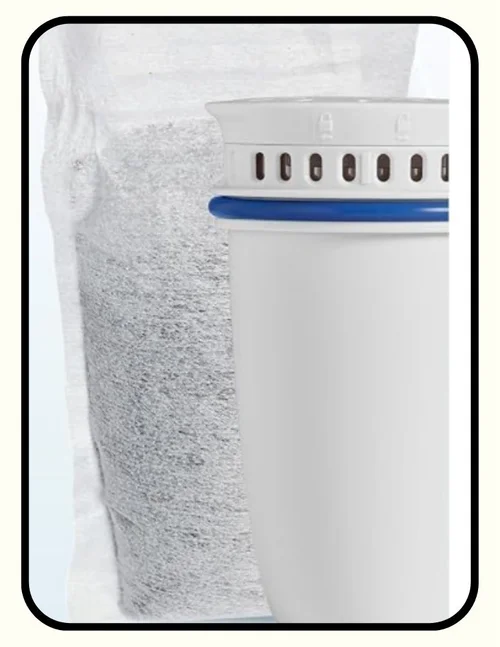 Brita Refillable Filter: Less Plastic Waste
Brita’s refillable filter is best if you’re more concerned about plastic waste than plastic contact. The refillable filter works the same in terms of water purification as Brita’s standard filter. It has the same certifications, lasts 40 gallons, and covers three contaminant groups: chlorine, mercury, and cadmium. But Brita says the refillable design cuts plastic waste by 80% over three years, which is a nice touch. Full contaminant comparisons are in my Drinking Water Filters table.
Product rating
Compare all water filters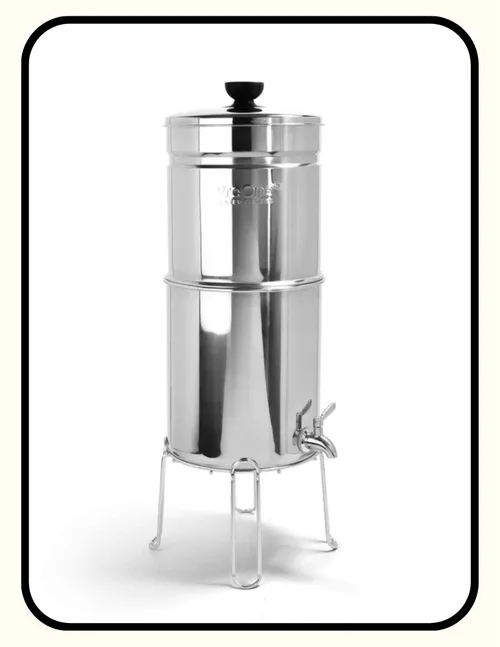 ProOne G3.0: Discounted Low Plastic Gravity Filter
Culligan bought ProOne, and ProOne’s G3.0 filters look like the same thing as the MaxClear filters. They have nearly identical specs, the same certifications, and the same 50 gallons per filter. ProOne is being phased out, so it’s a good time to get one of their stainless steel tanks on discount. Run 2 or 3 filters in the larger tanks to stretch time between replacements. The Big+ also fits other filters, including Culligan’s and Boroux’s, so you have options if ProOne filters go away.
Product rating
Compare all water filters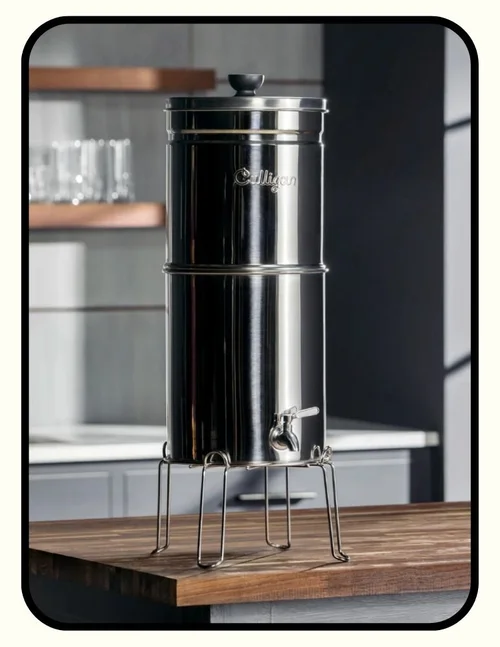 Culligan MaxClear: Certified Low Plastic Gravity Filter
MaxClear is where certified low plastic gravity filters start to thin out. It uses ceramic and carbon filters and is NSF certified for chlorine, chloramine, lead, all 7 PFAS, and microplastics, but again, with low capacity: only 50 gallons per filter. As you’ll see, removing those things with proof is quite rare for a gravity system, and this is a good water filter in this style.
Product rating
Compare all water filters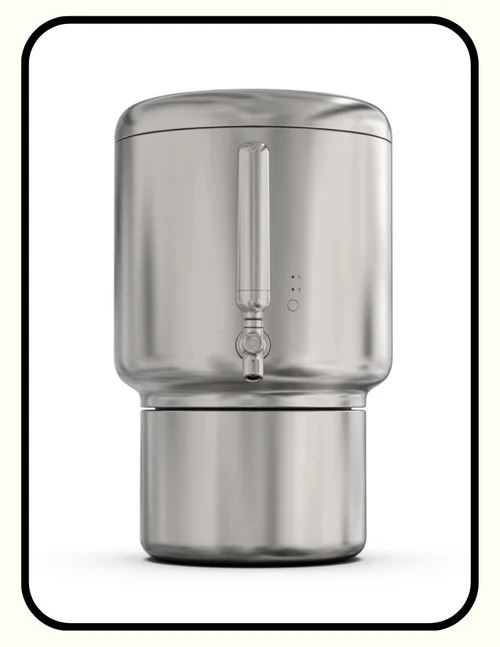 Rorra Stainless Steel Gravity Filter Review
The Rorra countertop water filter is stainless steel and close to plastic free, and I like a lot about it. It’s made in the US, it looks good, the filter lasts longer than ProOne’s or Culligan’s, and it filters quickly. But, the testing isn’t as impressive as it first appears: it passed a one-time NSF 42 test for chlorine, but that isn’t certification (certification means ongoing audits and retesting). The rest is one-time IAPMO testing. For microplastics they substituted a particulate reduction test, which uses mineral dust. Microplastics come in different shapes and behave differently in filter media, so that test is a stand-in. It probably removes some microplastics. If Rorra pursued certification for more contaminants, it would jump up this list.
Product rating
Compare all water filters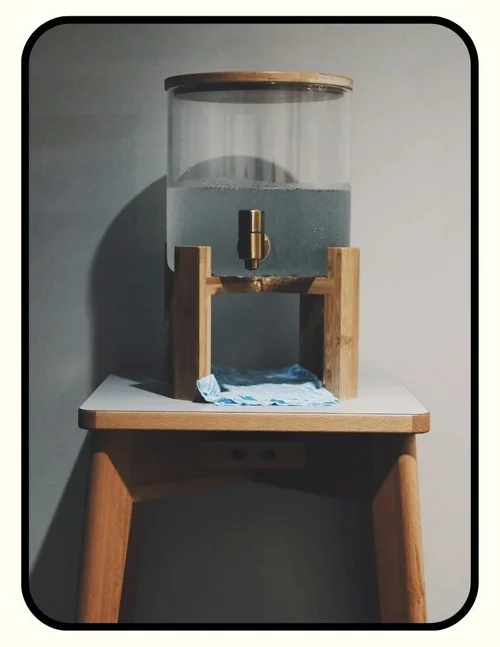 British Berkefeld Stainless Gravity Filter Review
Berkefeld’s Ultra Sterasyl and Fluoride filters are NSF certified for removing at least 85% of fine particles, microplastics and cysts. But it isn’t certified for any dissolved contaminants like lead, PFAS, chlorine, or fluoride. (Even the fluoride filter isn’t certified for fluoride which is strange, because fluoride certification exists and even ZeroWater above has it). A reminder that you can check anyone’s certifications against their website marketing in NSF’s database (or IAPMO or WQA’s).
Product rating
Compare all water filters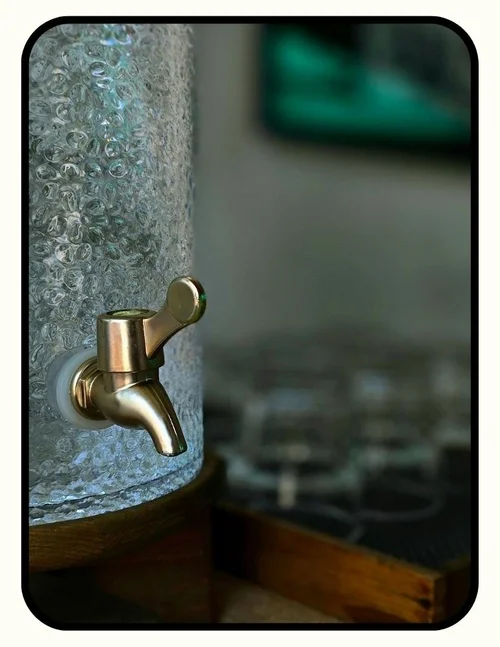 Berkey Review: Low Plastic, Weak Evidence
Berkey is probably the best known stainless steel filter, and the brand has lots of loyalty. But their track record for water filtration isn’t great. Their old filters, the Black Berkeys, never had NSF certification, and a consumer class action claims they didn’t remove contaminants at advertised levels. Their newer Phoenix filters are better but still not as good as advertised. They have testing from two labs in India, not IAPMO, WQA, NSF, or even SGS. The PFOA and PFOS test stopped at 396 gallons, far short of the 2,750 gallons claimed on their site. Fluoride, mercury and arsenic are listed on the site, but I couldn’t find them in any published report. These are low plastic but I’m not impressed with what they can actually remove.
Product rating
Compare all water filters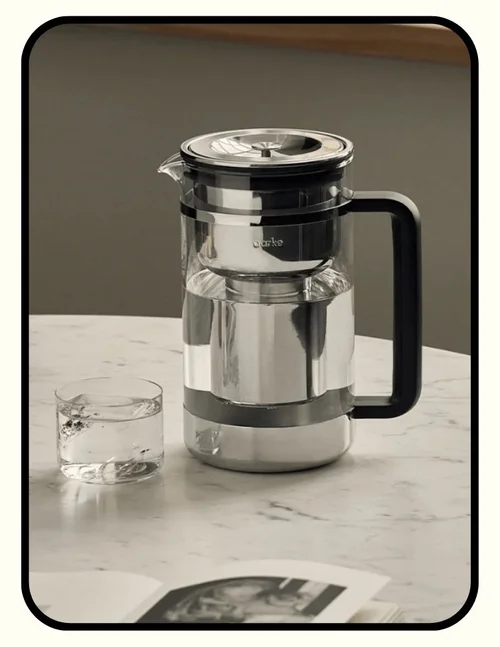 Aarke Glass and Stainless Steel Filter: Closest to Plastic Free
Aarke uses the least plastic of any water filter on this page. It’s glass and stainless steel, and instead of a plastic cartridge, you refill a stainless steel insert with filtration granules. The brand says the granules meet EN 17093:2018, the European standard for jug filters, and remove lead and chlorine for 31.7 gallons. But they don’t name a lab, a certificate, or any test results. That’s on par with a brand saying it uses an NSF certified component without showing actual removal values, so I can’t verify how well it works. I’m including it because the brand is honest and transparent, and it’s a good-looking glass filter. It’s also the clearest example of the tradeoff this page is about: plastic-free vs proven to remove a lot. I hope someday one filter does both.
Product rating
Compare all water filtersDon’t see what you’re looking for? Request a review, or check it yourself in seconds with the Second Opinion Product Checker. Spot something outdated? Let me know and I’ll update it. Join the spam-free newsletter for interesting info and to hear when new reviews are up.
FYI, “non-toxic” has no official definition, so I rate every product with the same method. It’s built on third-party certifications and published test data, not brand claims. For a deeper dive, my free course walks you through it.
Everything on Interior Medicine is educational information, not medical advice. Read my full disclaimer.
More Healthy Design For You

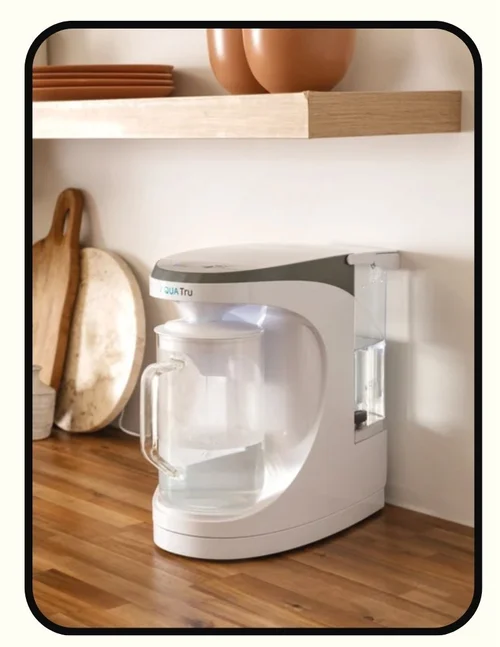

Methodology: How I Evaluate Plastic Free Water Filters
My Methodology page explains how I evaluate every product on Interior Medicine, including the Health Function Scale I use for each product category. For water filters, those scale requirements come straight from my Drinking Water Filters page.
There, I score every filter on how many contaminant groups it's verified to remove and how strong the evidence is for each one. Each group counts as 1 point when certified by NSF, IAPMO, or WQA, 0.75 when backed by a one-time independent lab test, 0.5 when brand tested, and 0.25 when claimed with no test report. That page has the full scoring method and each filter's complete contaminant list. The Health Function Scale listed below each product on this page is a shorthand for those scores, written out in brief here:
TIER 01
Highest
Water Purification
What qualifies
Verified to remove most of the 19 contaminant groups I track, with nearly every claim certified by NSF, IAPMO, or WQA.Score of 13 or more
Evidence / Info
Certification isn't a one-time test. It includes regular inspections of the manufacturing facility and periodic retesting of the product, which a one-time independent lab test doesn't (NSF).
TIER 02
High
Water Purification
What qualifies
Verified to remove a broad set of contaminant groups, or a longer list backed by a mix of certification and one-time independent lab testing.Score of 7 to 12.99
TIER 03
Moderate
Water Purification
What qualifies
Verified to remove a handful of contaminant groups, or a slightly longer list backed by independent lab testing.Score of 4 to 6.99
TIER 04
Low
Water Purification
What qualifies
Verified to remove two or three contaminant groups, or a few more with weaker evidence, like brand testing or lab testing instead of certification.Score of 2 to 3.99
TIER 05
Lowest
Water Purification
What qualifies
Verified to remove one contaminant group or none, or making claims with little or no evidence behind them. Many filters here are certified for a single group, usually chlorine or total dissolved solids (TDS).Score under 2
Compare all the scored water filters and see the contaminants removed in detail on the Drinking Water Filters page.
FAQ: More About Plastic Free Water Filters
Why are all water filters made with plastic?
I know, the great irony of water filters that remove microplastics from the water and made with plastic themselves. It’s frustrating, I use one anyway, and I still think they’re the best fit for most people as of late 2026. Here’s how I think about it:
The water that comes out of filter and into your cup will still have less microplastics than the city tap water. You can tell by looking at certifications and test results. Look for NSF/ANSI 401 certification with specific testing for microplastics. NSF 42 Class 1 certification for “nominal particle reduction” is often used as a stand-in for microplastic reduction, but is actually a test done on mineral particulates so it’s an imperfect comparison since microplastics come in many different shapes and have different binding properties than minerals. RO systems with NSF 58 probably remove microplastics, too, though it’s not a certified result.
The main way plastic releases additives into water are with heat, acid, time, or abrasion. (This is why it’s recommended you don’t drink out of plastic water bottles that have been left in a car or heated up in some way, for example.) Cold neutral water is less of an issue, and will not coax out nearly as many plastic additives, nor cause abrasion that could create meaningful microplastic quantities.
There are no totally plastic-free water filter membranes with plastic-free encasements on the market that are certified to remove PFAS, pharmaceuticals, chlorine, heavy metals, microplastics, and much else in your water. I check occasionally for this, but please let me know if you find one or make one.
Should I choose a plastic free water filter or a plastic water filter that removes microplastics?
Considering that water filters remove so much else from water like heavy metals, pharmaceuticals, PFAS, VOCs, pesticides, and more, a water filter made of plastic that removes more is better. I think avoiding plastics in other ways is ideal: they are truly all over the place, like in microfiber sheets and polyester duvet covers and tupperware and to-go containers and clothing and PVC piping and so on.